Home Blog Page 2

IBN TIBBON Doctoral and Teacher Training Translation Studies Summer School (DOTTSS) 2022

0

Granada, Spain: 27 June –8 July 2022

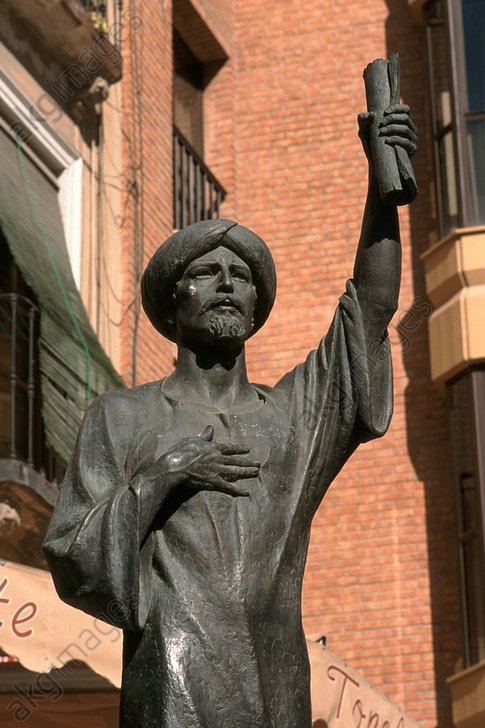
The Doctoral and Teacher-Training Translation Studies Summer School (DOTTSS) is a joint initiative of 5 different universities: University of Ljubljana (Slovenia), University of Turku (Finland), University of Tampere (Finland), University of Granada (Spain) and Boğaziçi University (Turkey). Since 2012 the summer school has hosted doctoral students of TS and teachers of translators and interpreters from all around the world. The first two schools were held in Piran, Slovenia (Emuni 2012, Stridon 2013), the third was in Granada, Spain (Ibn Tibbon 2014), the fourth in Turku, Finland (Agricola 2015), the fifth in Piran, Slovenia (Stridon 2016), the sixth in Granada, Spain (Ibn Tibbon 2017), the seventh in Tampere, Finland (DOTTSS 2018), the eighth in Ljubljana (Stridon 2019), the ninth online from Istanbul (Bosphorus 2021) and tenth edition will be held in Granada (Ibn Tibbon 2022). The name of the school in Granada pays homage to one of the greatest translators of the Western world, Ibn Tibbon, a native of Granada from arguably the most important Jewish family of translators, who undertook the translation into Hebrew of ethical and philosophical works written in Arabic by Jewish scholars from Spain.


2022 GUEST LECTURER
Prof. Dr  Maria González-Davies, FPCEE-Blanquerna, University Ramon Llull, Barcelona, Spain

TOPIC:  RESEARCH PATHWAYS IN TRANSLATION TRAINING AND BEYOND: A COLLABORATIVE AND SITUATED APPROACH

The sessions are designed to meet the needs of researchers and instructors who are interested in collaborative and situated models of learning and teaching and who wish to acquire a more solid foundation in innovative pedagogical and didactic theory and skills. The program will offer both intensive instruction and a forum for constructive dialogue as the curriculum includes reflection around the main pedagogical approaches and best situated practices in translator and interpreter training. Along with a survey of pedagogical principles, the participants will be provided with numerous opportunities to collaboratively develop their research and discuss their own teaching practices following the instructional framework presented by Richards and Rodgers (1986/2014): approach, design, and procedures. Finally, a session will be devoted to exploring the role of translation as described in well-informed plurilingual approaches to language learning.

Reference:

Richards, Jack and Theodore Rodgers (1986/2014). Approaches and Methods in Language Teaching, London and New York, Routledge.

The language of instruction is English.

MEMBERS OF THE STEERING COMMITTEE

Dr Dorothy Kelly, University of Granada, Spain

Dr Kaisa Koskinen, University of Tampere, Finland

Dr Outi Paloposki, Turku University, Finland

Dr Nike K. Pokorn, University of Ljubljana, Slovenia

Dr Sehnaz Tahir-Gürçağlar, Boğaziçi University, Turkey

MEMBERS OF THE LOCAL ORGANISING COMMITTEE

Dr Dorothy Kelly, University of Granada, Spain

Dr Elena Ruiz Cortés, University of Granada, Spain

TEACHING STAFF

Dr Nike K. Pokorn, University of Ljubljana, Slovenia

Dr Tamara Mikolič Južnič, University of Ljubljana, Slovenia

Dr Agnes Pisanski Peterlin, University of Ljubljana, Slovenia

Dr Outi Paloposki, Turku University, Finland

Dr Sehnaz Tahir-Gürçağlar, Boğaziçi University, Turkey

Dr Jonathan M. Ross, Boğaziçi University, Turkey

Dr Şule Demirkol, Boğaziçi University, Turkey

Dr Dorothy Kelly, University of Granada, Spain

Dr Catherine Way, University of Granada, Spain

Dr María del Mar Haro Soler, University of Granada, Spain

PARTICIPATION

Participation is intended for doctoral students in the early stages of their projects, and teachers of translation at the MA level or its equivalent. Also, other academics and professionals who are involved in research in translation and interpreting studies or in other fields of doctoral research where translation, interpreting or intercultural mediation is of focal interest are invited to participate.

Individualized tutorials will be organised. In tutorials the doctoral students have the opportunity to discuss their own individual projects with all the teachers of the school, including with the guest professor. Furthermore, each student is expected to present her/his research project, and will have the opportunity to debate issues, particularly relating to methodology, with their peers and the teaching staff of the summer school.

Participants shall be invited to submit an article to be refereed and published in a collective volume.

FEES AND PAYMENT

The whole fee for the Summer School is 750€. It covers:

a) registration fee,

b) tuition fee,

c) course materials,

e) access to University of Granada facilities.

The fee does not cover travel expenses, accommodation or meals. The School will recommend accommodation for students selected at a reasonable price.

A limited number of partial bursaries will be available for applicants who demonstrate need and merit. Any applicant wishing to be considered for a bursary must ensure that a bursary request accompanies their application to the school. In addition, interested students are advised to apply for the EST summer school scholarship. Your University may offer funding for participation in short mobilities such as this under the Erasmus+ Programme if it has a current Interinstitutional Agreement (IIA) with the University of Granada.

Once students have been accepted for the course, they are responsible for paying the fee. Only those who have been accepted by the board of the school and have paid the fee will receive an admission letter, which can be used for visa application.

An e-mail will be sent to the accepted candidates regarding payment procedure.

APPLICATION PROCESS

Application deadline: 18 April 2022.

Decisions notified by 28 April 2022

Students applying for the summer school are required:

a) To send a tentative research proposal (or statement of purpose) (max. two pages).

b) To send a recent curriculum vitae indicating experience and/or training in Translation Studies (max. two pages),

c) To fill in the application form (available here) and send everything to ibn_tibbon@ugr.es

Public Service Translation And Interpreting: A Way to Accessibility And Inclusion

0

Edited by Carmen VALERO-GARCÉS (University of Alcalá, Spain) and Soňa HODÁKOVÁ (Constantine the Philosopher University in Nitra, Slovakia)

The UN 2030 Agenda, among its main objectives and goals, promotes sustainable, inclusive and equal development. Achieving this objective requires alliances between countries so that a spirit of solidarity and inclusion can grow, and where accessibility to all services must be guaranteed.  Accessibility is fundamental to inclusion becoming a reality: it is not only about being able to physically enter and remain in a building, but also about being able to access information, content, communications and curricula. 

In the present historical moment, under the pressure of globalization and technological revolution, we are living through the inevitable transformation or even disappearance of countless professions (Rifkin 2010) and the transformation of the educational sector. Instead of disappearing, new and existing barriers are growing in an eternal paradox: on the one hand, the possibility of remote access to millions of information sources and services in certain languages has increased, but on the other hand, accessibility to these resources in less widely spoken languages or for people with limited digital capacity is often a daunting challenge.   

We are at a crucial juncture, both in terms of the perception and equitable distribution of these changes and also in terms of dealing with their consequences. The significance of this crossroads, coupled with the centrality of communication, translation and interpretation, is intensified by an avalanche of automatic translation, speech recognition, different modes of audiovisual and multimedia recreation and reproduction, and the need for instant and apparently universal access to information, culture and leisure. It is also exacerbated by the profound asymmetries, misunderstandings and cracks in globalization, and the growing imposition of productivity as an absolute goal (Gisbert & Torres 2018). Meanwhile the concept of equal access and inclusion seems to be fragmented, democratized or relativized. This leads us to a rather myopic or restrictive view of the concept of accessibility. 

Issue 1/2022 is devoted to analysing the level of accessibility in the complex area of Public Service Interpreting and Translation (PSIT). 

Topics of interest might include, but are not restricted to: 

  • PSIT training: new developments and challenges
  • Remote interpreting in public service settings
  • Technologies in PSIT: dangers and possibilities
  • The instrumentalization of communication strategies to serve the interests of institutions
  • Accessibility as a requirement to guarantee equality and non-discrimination of people who do not share a language and culture
  • Accessibility scenarios: mobility, communication and information, goods and services.
  • Language management and language rights as an inherent part of fundamental human rights. 

We welcome full-paper submissions reflecting the abovementioned issues. All articles must be written in English and should not exceed 7,000 words. We also welcome reviews of publications related to the main topic of this issue.

Deadline for full-paper submissions: 7 May 2022

Your submission should be sent via the journal website after your registration at: https://www.bridge.ff.ukf.sk/

Please follow the journal stylesheet athttps://www.bridge.ff.ukf.sk/index.php/bridge/about/submissions

References:

Bustos Gisbert, José  & Torres del Rey, Jesús. 2018.  Los nuevos caminos de la Traducción. The New Paths of Translation. Prefacio. In: CLINA Vol. 4 (2), pp. 7-11. DOI: https://doi.org/10.14201/clina201842711

De Cotret, Francois R., Beaudoin-Julien, Andrée-Anne & Leanza, Yvan. 2020. Implementing and managing remote public service interpreting in response to COVID-19 and other challenges of globalization. In: Érudit, Meta. 65 (3). pp 618-642. DOI https://doi.org/10.7202/1077406ar

Rifkin, Jeremy. 2010. La civilización empática. La carrera hacia una conciencia global en un mundo en crisis. Barcelona: Paidos.

Valero-Garcés, Carmen & Martin Anne (eds.). 2008. Crossing Borders in Community Interpreting. Amsterdam/Philadelphia: John Benjamins Publishing Company. DOI https://doi.org/10.1075/btl.76

Valero-Garcés, Carmen. 2018. TISP y tecnología. Retos en la era digital. In: Valero-Garcés, Carmen (ed.). TISP y tecnología. Retos en la era digital. Alcalá de Henares: Servicio de Publicaciones de la Universidad de Alcalá.  pp. 1-12.

Cfp: Special Issue- New Trends, Challenges and Discoveries in the Translation of Multilingualism in Fiction

0

Special Issue Information

Dear Colleagues,

The past decade has seen a substantial rise in research publications focused more and more on the issue of translation tasks and projects having to tackle with texts that are not limited to a single language, dialect, or sociolect (Beseghi 2017, Ranzato and Zanotti 2018, Pérez and de Higes 2019, Rebane and Junkerjürgen 2019, to mention but a few). In other words, they display, and play with, the inclusion of words or phrases that do not belong to the standard language norm of the main language the text is composed in. The decade(s) before that required that such studies be introduced by a justification of the importance or relevance of language variation within texts (e.g., Sternberg 1981, Delabastita and Grutman 2005, Bleichenbacher 2008, Corrius and Zabalbeascoa 2011). This is no longer necessary nor is it accurate to claim that there is a woeful lack of studies on this topic. So, the question now is how far have we come exactly in our progress towards including this kind of sensitivity in the mainstream of translation studies, both theoretically and in the applied domain of professional practice and academic training?

How is (yet another) dichotomy—of foreign vs. non-foreign—called into question by multilingual phenomena, such as creoles and code-switching, which are not necessarily based on the same factors as national borders, especially if we take into account multilingual communities and co-official languages within a given country? 

This Special Issue aims to address this question by accepting submissions that deal with it from different angles such as the ones suggested here but not limited to them:

  • Are translators proficient in all the languages of a multilingual fictional text (e.g., a novel or television series), and do they need to be?
  • How is multilingualism in fiction an element of an author’s style and how is multilingualism dealt with accordingly?
  • What strategies are used by translators in rendering scripted multilingualism and how they are affected by the habitual strategies involved in translation practices?
  • How have stereotypes (of character portrayal, conversational patterns or topics, or situations or events) developed and changed regarding the strategic use of foreign languages, dialects and non-native use of languages?
  • What are the practices and trends of using and rendering invented languages (e.g., as spoken by aliens from other planets or fantasy worlds)?
  • Are translations becoming more multilingual or linguistically diverse and, if so, by what means?
  • What genres and text-types are more affected by multilingualism, more problematic or innovative in translation?
  • In what aspects can / must we revise traditional theoretical approaches in the light of discoveries made in the area of multilingual translation? What about less traditional approaches, such as taking LGBTiQ+ studies/factors into account, or racial discourse, etc.?
  • To what extent is lingua franca a factor, and directionality, as in the distinction between from English vs. into English, for instance, or between languages that are not widespread on a global level?
  • Are there significant differences depending on whether the texts are written or audiovisual, i.e., mode and multimodality?
  • What are the relations between translation, multilingualism, pseudotranslations, creoles, code-switching, slang, non-native speech and other manifestations of sociolinguistic variation?
  • What historical periods can be meaningfully sketched both in the use of multilingualism in film, television, and video on demand, and the way they were and have been translated? What are the key characteristics of each period and the key factors of change from one period to another?
  • How have the researchers’ interests in the field of translation studies been sparked, what is the focus of their research and how has it evolved? What other aspects of translation has multilingualism been related to?
  • How is multilingualism tackled in machine translation, artificial intelligence, templates for translators, and post-editing practices?

We request that, prior to submitting a manuscript, interested authors initially submit a proposed title and an abstract of 400-600 words summarizing their intended contribution. Please send it to the guest editor (patrick.zabalbeascoa@upf.edu) or to Languages editorial office (languages@mdpi.com). Abstracts will be reviewed by the guest editor for the purposes of ensuring proper fit within the scope of the Special Issue. Full manuscripts will undergo double-blind peer-review.

Tentative completion schedule:

Abstract submission deadline: 12th October 2022

Notification of abstract acceptance: 20th November 2022

Full manuscript deadline: 20th January 2023

References

Beseghi, M. 2017. Multilingual Films in Translation. A Sociolingusitic and Intercultural Study of Diasporic Films. Oxford: Peter Lang.

Bleichenbacher, L. 2008. Multilingualism in the Movies: Hollywood Characters and Their Language Choices. Tübingen: Francke.

Corrius, M. & Zabalbeascoa, P. 2011. “Language variation in source texts and their translations. The case of L3 in film translation”. In: Target 23 (1), 113—130.

Delabastita, D. & Grutman, R. (eds.) 2005. Linguistica Antverpiensa 4, 11—34. DOI: https://doi.org/10.52034/lanstts.v4i

Pérez L. de Heredia, M. & de Higes, I. 2019. Revistas – MonTI – 2019, Special Issue 4. Multilingualism and Representation of Identities in Audiovisual Texts. University of Alicante.

Ranzato, I. & Zanotti, S. 2018. Linguistic and Cultural Representations in Audiovisual Translation. New York: Routledge.

Rebane, G. & Junkerjürgen, R. 2019. Multilingualism in Film. Peter Lang.

Sternberg, M. 1981. Polylingualism as reality and translation as mimesis. In: Poetics Today 2 (2), 221—239.

Prof. Dr. Patrick Zabalbeascoa
Guest Editor

Manuscript Submission Information

Manuscripts should be submitted online at www.mdpi.com by registering and logging in to this website. Once you are registered, click here to go to the submission form. Manuscripts can be submitted until the deadline. All submissions that pass pre-check are peer-reviewed. Accepted papers will be published continuously in the journal (as soon as accepted) and will be listed together on the special issue website. Research articles, review articles as well as short communications are invited. For planned papers, a title and short abstract (about 100 words) can be sent to the Editorial Office for announcement on this website.

Submitted manuscripts should not have been published previously, nor be under consideration for publication elsewhere (except conference proceedings papers). All manuscripts are thoroughly refereed through a double-blind peer-review process. A guide for authors and other relevant information for submission of manuscripts is available on the Instructions for Authors page. Languages is an international peer-reviewed open access quarterly journal published by MDPI.

Please visit the Instructions for Authors page before submitting a manuscript. The Article Processing Charge (APC) for publication in this open access journal is 1400 CHF (Swiss Francs). Submitted papers should be well formatted and use good English. Authors may use MDPI’s English editing service prior to publication or during author revisions.

Cfp: Special Issue – Research, pedagogy and practice of translation and interpretation

0

Call for Papers

JRHE, the Journal of Research in Higher Education published by Babeș-Bolyai University, the QUALITAS Centre, invites submissions for the forthcoming special issue on the research, pedagogy and practice of translation and interpretation, due out in September 2022. JRHE is a peer-reviewed, open access journal http://jrehe.reviste.ubbcluj.ro/, that seeks to address and factor in the major challenges educators, researchers, trainers and trainers of trainers in the field  are faced with in these accelerated global times.

As well as the changing professional communication patterns and policies manifesting themselves at this juncture in pandemic times, the volume sets out to engage the transformative forces impacting these academic subjects and the global language industry in the age of digital literacies and remote teaching. Fostering transdisciplinarity and multilingualism at the highest professional level in the language industry par excellence, the Department of Applied Modern Languages at BBU – a pioneering department in the country, marking its 30th anniversary in Higher Education in Romania–  commissions state-of-the art contributions that cover the terrain of translation and interpretation studies.

Submission topics may include, but are not limited to:

  • Advanced technology applications in the pedagogies of CI and TS;
  • Multimodality in T & I (audiovisuality, video-gaming, subtitling et al);
  • Remote interpreting, I&T teaching and re-speaking;
  • The cultural and ‘geo’ turn in translation studies;
  • Posthumanities and translation and interpretation practice;
  • Translation and interpretation and their territorial politics/policies;

Abstracts for paper presentations will be accepted until 30th June ‘22. Contributions will be in English, in the region of 4,500 words or above, directed to adriana.neagu@ubbcluj.ro, home editor. Special guest editor (to be confirmed).

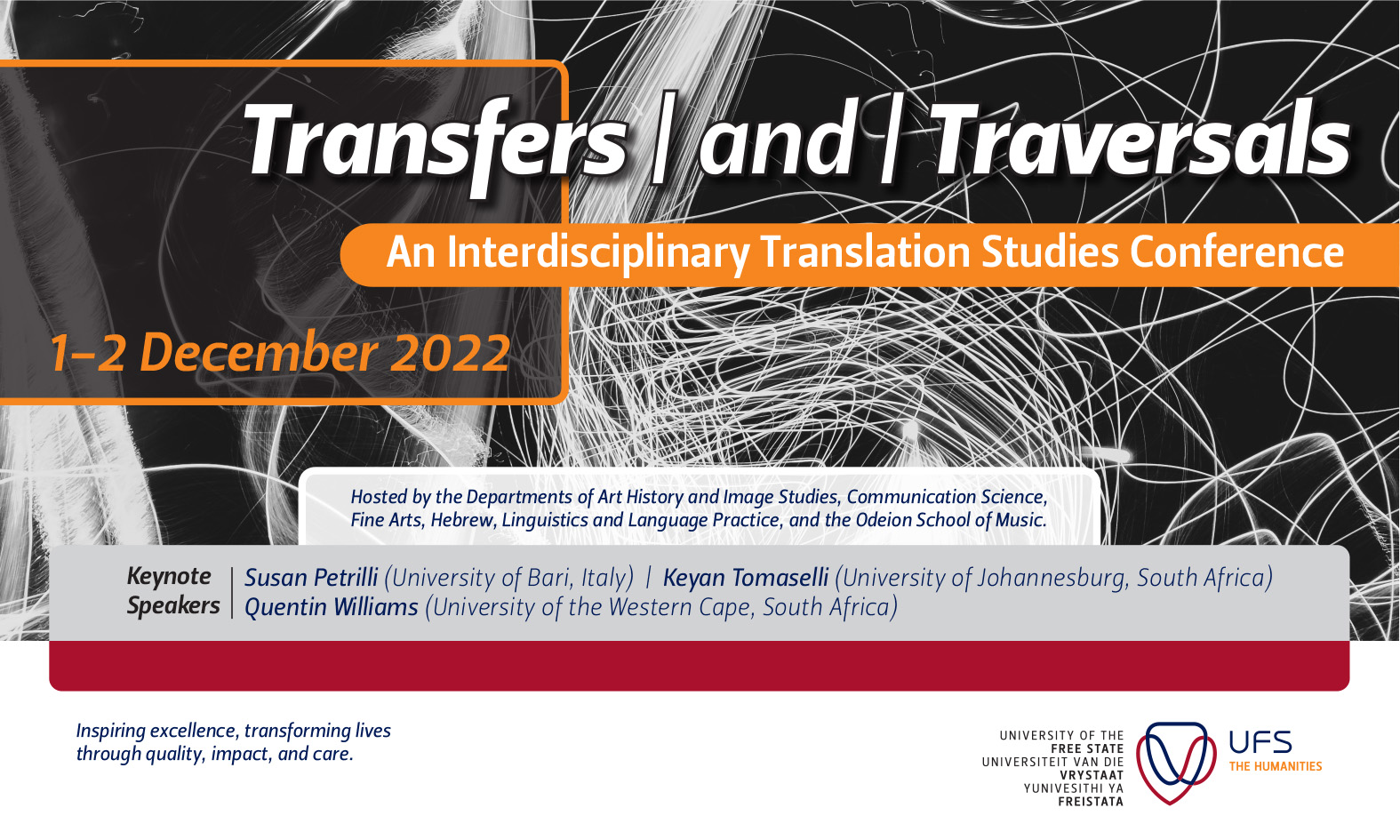
Transfers and Traversals: An Interdisciplinary Translation Studies Conference

0

In December 2022, the University of the Free State will be hosting an interdisciplinary translation studies conference, ‘Transfers | and | Traversals’, for which we are presently inviting abstracts. At this stage, we are planning for a face-to-face conference on the Bloemfontein campus of the university, but our arrangements regarding the format will remain flexible depending on the pandemic.

Conference Theme

Having long exceeded the purview of traditional translation studies, the theme of translation opens a fertile interdisciplinary space that brings into dialogue a range of disciplines in academia. In the Humanities, these include fields as diverse as philosophy, anthropology, cultural studies, comparative literature, comparative arts, adaptation studies, art history and visual culture studies. In the social sciences, sociology, law, business studies and economics can be included as fields invested in issues of translation. Likewise, in the natural sciences, mathematics, computer science, medical science and biology use the term and have an interest in translation at both conceptual and practical level. All of these disciplines use translation as a concept, category or theme in thinking about the emergence of social-cultural phenomena, practices and processes, as well as in thinking about forms of knowledge more broadly. 

An expanded category for understanding translation is also emerging from within translation studies itself where the focus is increasingly pushed beyond conventional interlingual translations to also investigate intersemiotic or multimodal translations of cultures, artefacts, practices and processes (Aguiar and Queiroz 2013, Marais 2019, Petrilli 2003). Conceptualized semiotically, in that (following Peirce) the meaning of any sign(s) is its translation into another sign(s), translation includes all meaning-making and meaning-taking actions that underlie the interaction between living organisms, generally, and human beings, specifically. Whether one studies the emergence of society-culture from the perspective of, for example, aesthetics, computer science, law or biology, you will at some point face the problem of meaning-making. This means that translation, if regarded as the process underlying the emergence of societyculture, could offer a handy gateway to inter or even transdisciplinary studies that include the humanities, the social sciences and the sciences. In addition, one finds proliferating cultural forms such as adaptations, remediations, remixes, gamifications, and transmedia story worlds that are deeply receptive to such analysis owing to their inherently ‘translational’ nature. Scholars from all fields of study moreover face questions about knowledge creation, the translation of pure knowledge into applied knowledge, translations between specialists (e.g. medicine and law), the ways in which knowledge travels, etc. Ultimately, the very nature of interdisciplinary collaboration as such is frequently conceived of in terms of ‘translations’—a probing metaconcept for thinking about the various orders of transfer and transversal that occur when disciplines operate side-by-side. 

Against this background, the organizers invite abstracts that address any of these issues—from any field of research. While this particular call originated from the Humanities, we hope to initiate discussion between as many fields of study as possible.

Possible topics could include the following: 

  • the study and critical analysis of any translations, adaptations, remediations, remixes, gamifications, transmediations, intermedialities, appropriations, and so forth, from an inter- or multidisciplinary perspective
  • epistemological, social, political, legal, ethical-moral, and/or legal aspects of (interlinguistic, intersemiotic, intercultural, intermedial, interart) translations or translational processes
  • cultural (or cross-cultural) translation, dialogue, appropriation, transfer, and migration— as conceived of within historical inquiry, postcolonial studies, critical race theory, and beyond
  • the study—whether theoretical, experimental, or performative—of relations, interactions and creative translations between arts and/or media (e.g. between music and fine art; between theatre and literature; between film and video games)
  • the translation and application of vocational knowledge, skills, practices, or ‘know-how’ (e.g. of mathematicians, medical specialists, computer scientists, engineers, architects, legal experts, theologians) within other, seemingly unrelated, societal spheres
  • questions about knowledge translation, sociology of knowledge, etc.
  • issues concerning (the concept of) translation as a facilitator of inter-, multi-, post- or transdisciplinary research, including perspectives from ecology studies
  • the productive transfer, translation, and transformation of any meta-discourse— concepts, models, theories, methods, research practices, or knowledge cultures—from one academic discipline to another. 


Timeline, Abstracts, Arrangements

Submission of abstracts: 15 April 2022

Presenters notified of outcome of review process: 1 May 2022

Registrations open: 1 August 2022

Registrations close: 15 October 2022

Conference: 1-2 December 2022

For queries or the submission of abstracts contact
E: Transfers2022@ufs.ac.za.

Please submit abstracts before 1 April 2022. Kindly include with the abstract of ca. 300 words a brief bio of 100 –150 words.

The conference is organized by the Departments of Art History and Image Studies, Communication Science, Fine Arts, Hebrew, Linguistics and Language Practice, as well as the Odeion School of Music at the University of the Free State, South Africa.

Details regarding options for accommodation etc. will be communicated closer to the event.

The organizers are investing a number of publication options, depending on interest.

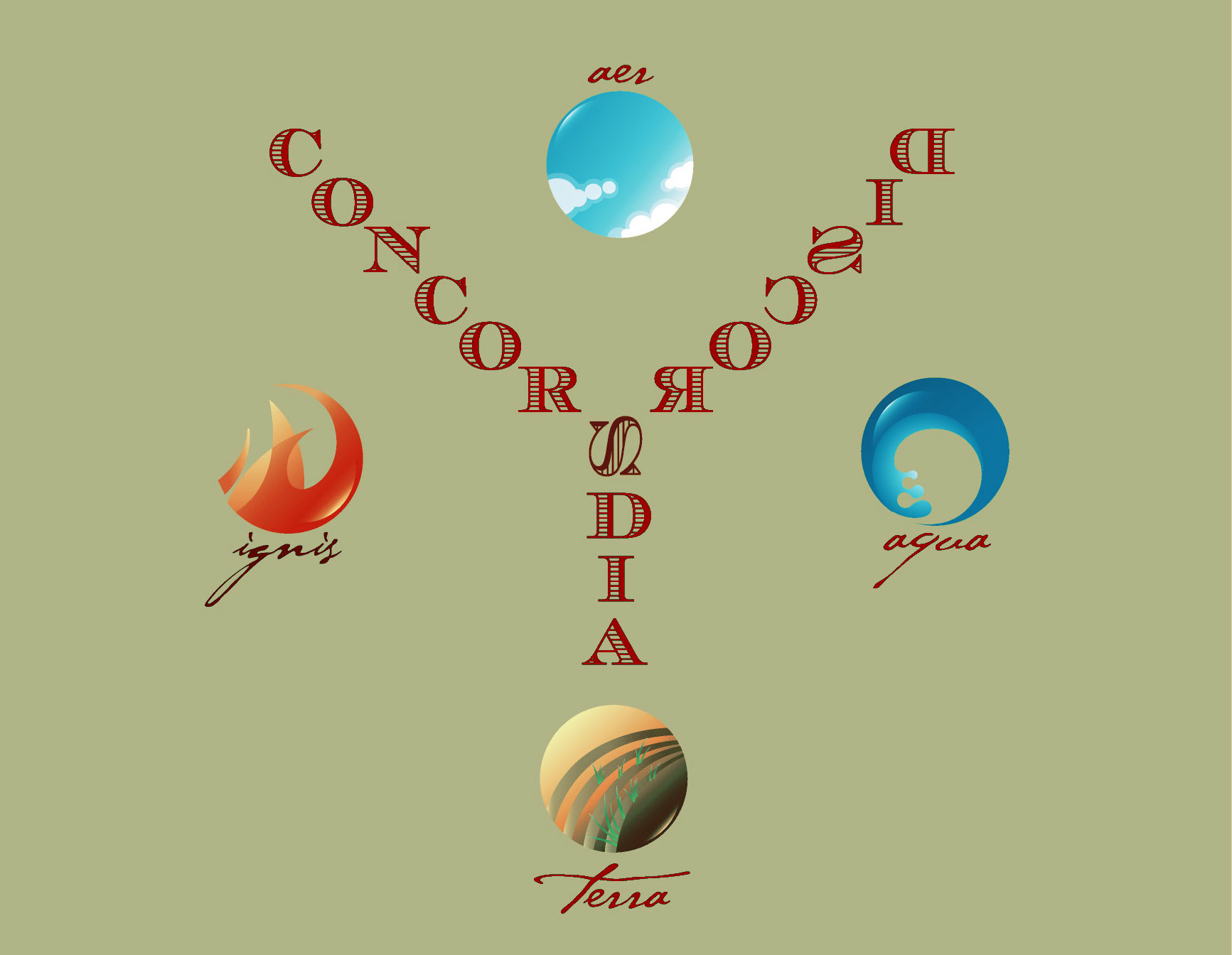
INTERSEMIOTICITY, INTERGENERICITY, INTERMEDIALITY: FROM TRANSLATION TO DRAMATISATION, ADAPTATION, PERFORMANCE

0

Call For Papers

Concordia Discors vs. Discordia Concors

(International Journal for Researches into Comparative Literature, Contrastive Linguistics, Cross-Cultural and Translation Strategies)

no. 17-18 / 2022

INTERSEMIOTICITY, INTERGENERICITY, INTERMEDIALITY: FROM TRANSLATION TO DRAMATISATION, ADAPTATION, PERFORMANCE

Roman Jakobson’s On Linguistic Aspects of Translation (1959) is still a much quoted (re)source, above all for having introduced the concept of intersemioticity or transmutation as “the interpretation of verbal signs by means of signs of non-verbal sign systems”. For the 17th and 18th issues of Concordia Discors vs. Discordia Concors, we propose a reflection on translation and adaptation as a passage, not only from verbal to non-verbal, but also from a genre to another, and also from a medium to another.

Whether we see intersemioticity, along with Aba-Carina Pârlog (2019) as a prism,or we consider it a metamorphosis or mutation, it is always reinvention, extension, addition, and not a simple repetition of an “original” text. Umberto Eco (2003) argues that intersemiotic translations or transmutations (in Jakobsonian terms) are nothing but adaptations, as they reshape previous texts due to their tendency to ‘say too much.’ Much like translations, adaptations are usually judged in terms of their fidelity to a prototext, even if a change of medium is involved. In keeping with the so-called archontic literature, which posits that texts based upon or referring to other texts are never simply derivative or subordinate, they do not retell or repeat a story; they rather build an archive that expands the textual world.

Intergenericity explores the translation potential of generic interactions and influences. Considering genre from a linguistic perspective, as a text type, spoken or written, but also, from a social perspective, as an “activity type” (Fairclough, 1992) closely connected with the subject positions that are socially determined, we focus on the relationship between authorial and lectorial genericity. In the latter part of the 19th century and the former of the 20th, novelists used to “dramatise” their fiction, either in order to protect it against unauthorised dramatisation or for much more than reasons of copyright (see Henry James’ Daisy Miller, Thomas Hardy’s Tess of the D’Urbervilles, Joseph Conrad’s The Secret Agent, or J. M. Barrie with his books featuring Peter Pan).

The process of self-adaptation is, as shown by Richard James Hand (1996), illuminating because it reveals much about the way these novelists saw their fiction as well as the broader perception of their culture.

Due to the fact that Jakobson’s concept of intersemiotic translation is limiting, as the source medium is traditionally a written text, intermediality came to definevarious interactions among media, dissociating the translation from its strictly linguistic meaning (Shober, 2010). According to Lars Elleström (2010), every medium is constituted of four necessary conditions or basic modalities: material, sensorial, spatiotemporal and semiotic, in such a way that even the apparently monomodal text is, in fact, multimodal. Consequently, as intermediality is “the result of constructed media borders being trespassed,’’ various signs may be part of various systems at the same time without losing their stability. We understand, therefore, intermedial translation both as the adaptation and transmission of a literary work through another medium, and as interactions amongotherdifferent media, such as, for instance, Amy Lowell’s poetic translation of Stravinsky’s music (Shober), or Marie Chouinard’s choreographical translation of Hieronymus Bosch’s painting  The Garden of Earthly Delights (Montesi, 2021).

As Martha Dvořák (2012) claims, “text in the original etymological sense of textus(surface, material, base) signifying the concrete bottom or supporting part has mutated – mutated to an immaterial mental state, but also to other forms of material, other cultural media, transforming intertextuality to intergenericity, intersemioticity, or rather, intermediality”.

We kindly invite subsmissions in English, French, German, Italian or Spanish for the 17th and 18th issuesof the peer-reviewed academic journal Concordia Discors vs. Discordia Concors: Researches into Comparative Literature, Contrastive Linguistics, Cross-Cultural and Translation Strategies (http://condisdiscon.blogspot.com/2021) on one of the following subtopics (but not only):

  • musicalisation of literature
  • ekphrasis
  • from picaresque to picturesque
  • from the book to the screen
  • from the book to the stage
  • digital art
  • movement as translation
  • from stage/screen to page; text as anchorage
  • the socio-cultural meaning of  the material expression of signs; substances/surfaces of production (ink, gold, paint, etc./paper, canvas, wood, etc.)
  • intermediality and interartiality
  • adaptation as reverence or subversion towards source texts
  • intermediality in graphic novels
  • intersemiotic translation and the burden of historical and cultural context

A special section will be dedicated to interviews, reviews of publications, as well as research progress reports in adjacent thematic areas.

Interviews and reviews of recent books / plays / films / musical performances / art exhibitions are also accepted, which need not relate to the topic at issue.

Abstracts:

  • should be submitted in English and not exceed 150 words
  • should include 5 keywords, as well a short bionote in English (indicating author’s name, affiliation, academic / research areas of interst, email)
  • should indicate the section preferred (Comparative Literature, Constrastive Linguistics, Cross-Cultural Strategies, Translation Strategies, Cross-Artistic Approaches, Reviews and Presentations)

Contributions in extenso should be sent no later than September 1st 2022 to the following email addresses:

Daniela Hăisan: danielahaisan@litere.usv.ro

Raluca Balaţchi: raluca.balatchi@usm.ro

Daniela-Maria Marţole: danielamartole@yahoo.com

REFERENCES

Byden, Diana; Martha Dvořák, eds., 2012, Crosstalk: Canadian and Global Imaginaries in Dialogue, Wilfred Laurier University Press

Brower, Reuben Arthur, ed., 1959, On Translation, Harvard Studies in Comparative Literature,vol. 23, Harvard University Press

Dvořák, Martha, 2012, “Rejoinders in a Planetary Dialogue”, in Diana Byden and Martha Dvořák, eds., Crosstalk: Canadian and Global Imaginaries in Dialogue, Wilfred Laurier University Press, pp.111-134

Eco, Umberto, 2003, Mouse or Rat. Translation as Negotiation, London: Orion Publishing Group

Elleström, Lars, ed., 2010, Media Borders. Multimodality and Intermediality, London, Palgrave, Macmillan

Fairclough, Norman, 1992, Discourse and Social Change, Cambridge: Polity Press

Hand, Richard James, 1996, Self-Adaptation: The Stage Dramatisation of Fiction by Novelists, PhD thesis, http://theses.gla.ac.uk/1912/

Jakobson, Roman, 1959, “On Linguistic Aspects of Translation”, in Brower, Reuben Arthur (ed), On translation, Harvard University Press, pp. 232-240

Montesi, Vanessa, 1921, “Translating Paintings into Dance: Marie Chouinard’s The Garden of Earthly Delights and the Challenges Posed to a Verbal-based Concept of Translation”, in The Journal of Specialised Translation, 35, pp. 166-185

Pârlog, Aba-Carina, 2019, Intersemiotic Translation: Linguistic and literary Multimodality, Springer International Publishing; Palgrave Pivot

Shober, Regina, 2010, “Translating Sounds: IntermedialExchanges in AmyLowell’s Stravinsky’s Three Pieces ‘Grotesque’ for String Quartet”, in Lars Elleström (ed) 2010, Media Borders, Multimodality and Intermediality, London, Palgrave Macmillan, pp. 163- 175

Contact Info: 

Dr. Daniela Haisan, Assoc. Prof., Stefan cel Mare University of Suceava, RomaniaContact Email: danielahaisan@litere.usv.roURL: http://condisdiscon.blogspot.com/

CfP: Unending Translation: Creative Critical Experiments in Translation and Life Writing

0

Deadline for submissions: April 15, 2022

Organization: Delphine Grass/Lancaster University, Lily Robert-Foley / Université Paul Valéry Montpellier

contact email: lily.robert-foley@univ-montp3.fr

The aim of this collected edition is to explore different approaches to translation criticism through the medium of life writing. Traditionally assigned to the paratextual, the translator’s point of view rarely occupies the narrative centre of creative writing and essays. In recent years, however, contemporary translators have taken on a more prominent role in translation criticism, exploring their practice through the medium of memoirs and experimental essays allowing for fragmentation, doubt and openness to be expressed in subjective modes of writing. The translational turn to life writing and the essay can be interpreted as a challenge to the separation between practice and theory which traditionally exists in translation studies. On the one hand, the meeting between translation and life writing can be seen as an attempt to rethink autobiographical forms, reinventing the terms within which we create, shape and think the category of the subject through literature. On the other, creative-critical experiments in essay writing and translation have allowed for a more embodied and situated critical engagement with translation, an opportunity to explore translation as a practice-led thinking of texts and writing in their own right. The meeting between translation and life writing thus shifts our literary focus from thinking about the essence of individual works to thinking about translation as a space of subjective and material entanglement, a practice capable of re-imagining relations not only between cultures but between the traditionally opposed practices of reading and writing, thinking and doing.

In this collected monograph, we ask and call for translators, writers, teachers and critics to approach translation practice from such an embodied, situated position. What happens when translation meets life writing? But also, what happens when translation shapes the essay as a form, and when the essay in its turn continues translation? What happens, in other words, when translation practice becomes the subject rather than the object of literary introspection? How can life writing accounts of translation make us rethink our understanding of the relationship between translation and politics, translation and life?

We welcome experimental essays and life writing experiments, for example: 

– Stories of a translator’s personal experience that narrate the interpretive experience as a writerly one.

– Experimental approaches to translation that rewrite a text through the translator’s engagement with it, or perhaps weave together different types of text, playing with form.

– Reflections on the subject position and voice of the translator, both as a lived experience but also as a politically situated one that is enjoined to tackle on the one hand the appropriative gesture of translation and on the other, the marginalised, secondary position that translation takes in traditional binaries of original/translation.

– Writings that play on the form of the translator’s commentary, responding to the traditional forms of translator prefaces, footnotes etc.

– Essays that multiply translational variants through a collection of hybrid approaches.

– Translations where the figure of the author is translated into the figure of the translator

– Stories of translation that give unique openings onto texts, for example through the interweaving of translation and commentary in the translation of genetic material (manuscripts, authorial marginalia, intertexts etc.)

– Writings that explore translation as fiction, in the sense given by Kate Briggs as an invitation to suspend one’s disbelief, to enter the foreign as though it is familiar, but also that tell a story of the time and place of the translating figure.

– Writings that visibilise the translator’s voice but their process and technique, challenging the injunction to produce a unitary, sole text as a finished product to be sellable.

– Translator writings that reflect upon political and identity dynamics such as feminist translation or decolonial practices. Reflections on the specificity of translating minority, regional, non-standardized or non-national languages are also welcome here.

– Heterolingual experiences that mix languages, texts, translations and originals and deterritorialize the attachment of languages to nation states.

Bibliography

C. Bergvall (2016) Drift. Brooklyn, Nightboat.

K. Briggs (2018) This Little Art. London, Fitzcarraldo Editions.

B. Brown (2011) The Poems of Gaius Valerius Catullus. San Francisco, CA, Krupskaya.

                  – (2012) Flowering Mall. Berkeley, Roof.

J. Butler. (2019) ‘Gender in Translation: Beyond Monolingualism’, Philosophia. Albany, N.Y. Vol.9 (1), pp.1-25.

A. Carson (2009) Nox. NYC, New Directions.

S. Collins (2016) Currently & Emotion.Londres, Test Centre.

M. Gansel (2017) Translation as Transhumance, trans. by Ros Schwartz. London, Les Fugitives

D. Grass (2021) ‘Translating the Archives: An Autotheoretical Experiment’, in Thinking Through Relation: Encounters in Creative Critical Writing. ed. by Florian Mussgnug, Mathelinda Nabugodi and Thea Petrou. London, Peter Lang.

T. Hermans (1996) ‘The Translator’s Voice in Translated Narrative’, in Target. International Journal of Translation Studies. Vol.8 (1), pp. 23-48.

C. Gepner (2019) Traduire ou perdre pied. Paris, Contre-allée. 

N. Grunwald (2021) Sur les bouts de la langue: traduire en féministe/s. Paris: Contre-allée.

S. Kadiu (2019) Reflexive Translation Studies: Translation as Critical Reflection. London, UCL Press.

​​J. Lahiri (2016) In Other Words. New York, Knopf. 

S. De Lotbinière-Harwood (1991) Re-belle et infidèle, la traduction comme réecriture au féminin; the Body Bilingual, translation as rewriting in the feminine. Québec, Les Editions du remue-ménage/Women’s Press.

E. Mouré (2004) Sheep’s Vigil by a Fervent Person: A transelation of Alberto Caeiro/Fernando Pessoa’s Oguardador de rebanhos. Toronto,House of Anansi Press.

                  – (2014) Secession with Incession. Montréal, Book Thug.

J. Osman & J. Spahr (eds.) (2003) Chain 10: Translucinación. Philadelphia, PA, Temple University Press.

N. Ramayya (2019) States of the Body Produced by Love, Ignota Books.

L. Robert-Foley (2013) m. Luxembourg, Corrupt Press.

C. Rossi (2018) ‘Translation as a Creative Force’, The Routledge Handbook of Translation and Culture, ed. by Sue Ann Harding. London, Routledge.

M. de la Torre (2020) Repetition Nineteen. New York, Nightboat Books.

C. Wright (2013) Yoko Tawada’s Portrait of a Tongue. Ottawa, University of Ottowa Press.

Timeline:

Deadline for abstract proposals: April 15th, 2022

Response to proposals: May 15th, 2022

Completed articles due: October 15th 

Call for Papers: Translators’ [In]visibilities

0

25-26 February 2022, University of Calgary

This call for papers is for a two-day workshop on the theme Translators’ [In]visibilities focussing on the idea of ‘invisibility’ from multiple perspectives. Informed by scholarship in translation studies, in particular the work of Lawrence Venuti, especially The Translator’s Invisibility (3rd edition; Routledge 2018), we want to explore the ideas of visibility and invisibility across a range of approaches to studying, practicing and teaching translation.

We welcome contributions which will address the theme in any way, including but not limited to:  

‌development of translation practice across time and space

‌historical practices of translation

‌the contemporary practice of translation

‌collaborative translation practices

‌the role of translation in teaching. 

Keynote addresses will be delivered by Professor Lawrence Venuti (Temple University) and Professor Chana Kronfeld (University of California, Berkeley). 

Papers will be expected to be 15-20 minutes in length. Presenters will be invited to submit pieces based on their presentations for consideration afterwards for a publication emerging from this workshop.

Please send an abstract of no more than 250 words and a brief biography of no more than 75 words to TranslationWG@gmail.com by December 31, 2021.

The workshop will be held online due to COVID-19 considerations and so will be free and open for all to attend. However, should the local and international situation permit, the possibility of a hybrid event allowing both online and in-person participation will be considered.

This workshop is organized by the Translation Studies Working Group of the Calgary Institute for the Humanities at the University of Calgary, with the support of the Institute as well as of the Language Research Centre, the Classics & Religion Department and the Faculty of Arts at the University of Calgary.

CFP- Special Issue: Literary Multilingualism Studies: The Future of the Field

0

Full name / Name of organisation: Journal of Literary Multilingualism

Deadline for submissions: April 15, 2022

Contact email: j.taylor-batty@leedstrinity.ac.uk

Literary multilingualism studies is a relatively new but burgeoning area of research. With the impact of translation studies, the ‘transnational turn’ within literary studies, and the growing relevance of the ‘postmonolingual condition’ in the contemporary world, multilingual and translingual writing practices – considered in the past to be exceptional and unusual – are now at the forefront of literary studies.

Scholars from a diverse range of linguistic, cultural, political, disciplinary and theoretical positions are contributing to the field, engaging with literature of all periods and all parts of the world. This rich diversity, however, means that there is currently little consensus on established terminology and on how ‘literary multilingualism’ might be defined. In addition to this, scholarship is fragmented in the sense that scholars engaging in one field of the discipline are often unaware of work being done in others. There is thus a strong need for more dialogue.

For this inaugural issue of the Journal for Literary Multilingualism we invite scholars to engage in a dynamic assessment of the field and its future. What are the key questions and debates at stake within literary multilingualism studies? What terminology is essential to the study of literary multilingualism and how do we define those terms? What future directions does the field need to take? We also invite provocations and critiques of literary multilingualism studies thus far: what are its absences and blind spots? Which aspects of literary multilingualism have been neglected?

We particularly welcome explorations of the following topics:

  • Which concepts of language and of linguistic diversity can be of use for the study of literary multilingualism? What are the advantages and disadvantages of terms such as ‘translingual’, ‘multilingual’, the ‘monolingual paradigm’, ‘heteroglossia’, ‘born translated’ etc. Does any new terminology need to be developed?
  • What interdisciplinary possibilities are there between linguistics and literary scholarship? What is the potential impact of concepts such as code-switching, mixed languages, translanguaging, glossodiversity/semiodiversity, etc. on literary multilingualism studies?
  • How can scholarship in literary multilingualism do justice to the enormous diversity of forms of multilingualism and the different ideologies of language that have developed at different points in history and in different parts of the globe? How do we need to address these regional, temporal and political divergencies in the study of literary multilingualism? Which concepts and theories are needed to counterbalance the particular modern and European focus on monolingualism (e.g., responses to creolisation, postcolonial language use, the difference between the ‘vernacular’ and the ‘cosmopolitan’, etc.)?
  • What are the objects of literary multilingualism research (e.g., multilingual texts, translingual authors, institutions such as the publishing industry, etc.)? Are there any particular forms of literary multilingualism that have hitherto been neglected?
  • What are the scholarly, cultural and political objectives of literary multilingualism studies? What impact does literary multilingualism studies have (or need to have) on literary studies more generally?

We welcome informal queries, and potential contributors may submit an abstract by 31 October 2021 if they wish to receive initial feedback on their topic. Please direct queries to Juliette Taylor-Batty (Leeds Trinity University), j.taylor-batty@leedstrinity.ac.uk and Till Dembeck (Université du Luxembourg), till.dembeck@uni.lu.

The final deadline for the submission of articles of 6000-10000 words is 15 April 2022. Acceptance of the final articles is subject to double blind peer review. Please send articles as email attachments to Till Dembeck, Université du Luxembourg – till.dembeck@uni.lu.

Cfp: Museums as Spaces of Cultural Translation and Transfer

0

International Conference

University of Tartu, Estonia
10-11 May 2022

Over the past decades, Translation Studies scholars have systematically broadened the horizon of translation, moving beyond the textual and linguistic level to consider different forms of cultural transfer that entail processes of remediation. Museums, as places of encounter, transfer and learning, have thus been conceptualized as translational places, that is, ‘areas of intense interaction across languages, spaces defined by an acute consciousness of cultural negotiation’ (Cronin and Simon 2014; see also Simon 2019). 

Museums ‘translate’ or represent cultures and personal stories on behalf of their visitors through the selection and combination of objects and texts, and through various multi-modal displays (Neather 2005, 2008). As tourist destinations attracting an international audience, they also resort to interlingual and intersemiotic translations in order to cater for different language user needs. This distinction is captured in the idea of ‘museums as translations’ versus ‘translations in the museum’ (Sturge 2007). 

The spatial perspective introduces an exploration of the museum’s geographical ‘sitedness’ and embraces Clifford’s (1997) definition of museums as metaphorical ‘contact zones’ where figures of the Other are created and cultures are translated in specific ways, for specific audiences and with specific purposes in mind.

The conference allows for broad, metaphorical perspectives on translation and cultural transfer as well as micro-level analyses of translated material. The focus is interdisciplinary, including – but not limited to – translation studies, museum studies and cultural studies. Furthermore, the aim is to promote dialogue between disciplines and languages, but equally between theoretical and practitioner-based research. We encourage original angles, a focus on different types of museums and a wide (cultural) diversity of case studies.
 

Call for Abstracts

Questions to be addressed include, but are not limited to, the following:

  • How are the concepts of ‘cultural translation’ and ‘cultural transfer’ reflected in museum practices? What are conceptual differences and common grounds? Which perspectives and research methods are useful to study the various transfer processes in the contemporary museum?
  • What types of translation and transfer (interlingual, intralingual, intersemiotic, etc.) are present in museums? How do spatial, visual and textual resources interact multimodally?
  • How do translation practices and policies differ according to the type of museum (memorial museums, migration museums, ethnographic museums, etc.)? 
  • What is the role of different agents and stakeholders (curators, translators, local communities, visitors)? How do the various types of translation and transfer function as instruments of power?
  • How are (national or foreign, dominant or minor) cultures, identities and memories (re)imagined in museums? In what ways do forms of translation and transfer facilitate the interchange and cross-fertilization of cultures in the contact zone?
  • To what extent are museum concepts culturally defined? What are the indications of globalized museum practices nowadays?
  • How can we assess the importance of the digital space and the hybrid exhibition model for meaning-making in museums?


If you wish to present a paper, please send a brief abstract (300 words) and a short bio (50 words) to museumtranslation@ut.ee by midnight on 15 December 2021. If your abstract is selected, you will receive a notification of acceptance by 20 January 2022.

Language Policy: the conference language is English.

Venue: University of Tartu College of Foreign Languages and Cultures (J. Liivi street 4)

At the moment, the conference is planned as an on-site event. However, depending on the development of the pandemic, we will consider the possibility of making some parts available online.

This conference is organized in collaboration with the Cultural Transfer Research Group of the Enlight University Network.


References:

Clifford, J. (1997). Routes: Travel and translation in the late twentieth century. Cambridge, Mass: Harvard University Press.
Cronin, M. & Simon, S. (2014). Introduction: The city as translation zone, Translation Studies, 7:2, 119-132.
Neather, R. (2005). Translating the Museum: On Translation and (Cross-) Cultural Presentation in Contemporary China. In Juliane House et. al. (eds), Translation and the Construction of Identity, Seoul: IATIS, pp. 180-197.Neather, R. (2008). Translating Tea: On the Semiotics of Interlingual Practice in the Hong Kong Museum of Tea Ware. Meta: Translators’ Journal, 53(1), 218–240.
Simon, S. (2019). Translation sites: A field guide.  London ; New York : Routledge, Taylor & Francis group.
Sturge, K. (2007). Representing Others: Translation, Ethnography and the Museum. St. Jerome Pub.

For more information, Please visit the official conference website