
Home Blog Page 5

Call for Papers: 56th Linguistics Colloquium

0

International conference comprising all fields of linguistics

For the first time the event taking place as a free online event


Special theme:
Translation, Multilinguality and  Cognition 

Submission of abstracts: October 12, 2020
Submission of full papers:
February 28
                                                    

Keynote speakers
Philipp Koehn, Johns Hopkins University, USA
Jan Hajič, Charles University, Czech Republic
Christopher Manning, Stanford University, USA

Date of Conference: November 26 to 28, 2020

Since its inception in 1966, the Linguistics Colloquium has been held annually without interruption in a total of 18 European countries. Its long term continuity is ensured by a large international committee consisting of its previous organizers. The Colloquium is devoted to research in all areas of linguistics. It is open to different theoretical approaches and aims to create friendly and inspiring conditions for the fruitful exchange of ideas and results. It is also appreciated for its welcoming atmosphere and cooperative discussion culture open to scientists of all ages and nationalities.

Traditionally, authors submit an abstract which, upon acceptance, is presented and discussed at the conference. Afterwards, a full paper has to be submitted, taking into account the outcome of the scientific discussion. As usually, also this year we plan to publish the proceedings as a hardcover book in the series Linguistik International of the publishing house Peter Lang.

Like many other conferences, this year, for the first time in its history, the Linguistics Colloquium will be organized as an online event. As, despite regular attendance from overseas, the Colloquium has been mostly a European event so far, we hope that colleagues from other continents will see this as an opportunity to get to know the friendly and co-operative spirit of the colloquium. To further encourage this and because an online event requires less funding, as a novelty this year we decided to completely waive registration fees.

How the conference will be conducted?

In our experience, conferences with pre-recorded presentations have the drawbacks that all presenters have to deal with recording issues, and that a real live atmosphere promoting questions and discussion is hard to obtain.

Therefore, in order to keep as much of the Colloquium’s interactive character as possible, the conference will be held in the form of several parallel online sessions, each representing a thematic field and realized as a separate online meeting hosted by a session chair. To minimize technical overhead for participants, we will use the popular “Zoom” video conferencing software which is particularly user-friendly. Registered participants will receive links to the conference sessions. By clicking on these, participation is possible with almost any desktop PC, portable computer or smart device. No cost is involved on the side of the participants and no pre-installation of software is required. Only when clicking on the provided links the user may be asked to allow installation of the free Zoom software (or, alternatively, to rely on the browser). Speakers require devices with a camera and a microphone (e.g. a laptop or tablet computer) and will be allowed to make the presentation screen of their laptop available to the audience. Questions can be either asked using audio/video or in writing via Zoom’s chat function (in which case the chair person will read them out). To minimize the risk of technical difficulties, speakers and participants are encouraged to join a test session some time ahead of the conference (see schedule below).

We plan to record all sessions for the following reasons:

  • Speakers can receive a complimentary video of their presentation if desired.

  • We hope that after the conference many speakers will wish to have their presentations published online (e.g. as a service for participants who missed a session or to address a wider audience). But in any case the decision on publication will be entirely up to the speakers.

On the registration form, speakers will be asked to give their permission for their presentation being recorded. During discussions, participants should only ask questions using audio/video if they also agree on being recorded. If not, they are supposed to ask their questions in writing via Zoom’s chat function. We hope for participants’ understanding that switching the live stream recording on and off for individual speakers and questions would be a burden for the session chair and, during lively discussions involving several participants, appears too error prone to be practical.

Topic areas

The special theme of the conference is “Translation, Multilinguality and Cognition”. But contributions from all areas of linguistics are welcome, including but not limited to:

  • Theory of linguistics

  • Historical linguistics

  • Diachronic linguistics

  • Corpus linguistics, text mining

  • Computational linguistics, natural language processing

  • Neural language processing and machine learning

  • Comparative & contrastive linguistics, typology

  • Applied linguistics, language learning

  • Neuro- and psycholinguistics

  • Sociolinguistics

  • Lexicology, lexicography

  • Phonology, phonetics

  • Morphology

  • Syntax

  • Semantics

  • Pragmatics

  • Text / Discourse

  • Semiotics

Important dates

Oct. 12, 2020 Submission of abstracts (extended deadline)

Oct. 15, 2020 Notification of acceptance

Oct. 30, 2020 Registration for presenters (free of charge)

Nov. 14, 2020 Zoom trial session (test session to identify technical problems)

Nov. 22, 2020 Registration for participants without presentation (free of charge)

Nov. 26 to 28, 2020 Conference dates

Feb. 28, 2021 Submission of full papers

Submission
For submitting your abstract, by the deadline listed above, please send the following information by e-mail to lingcoll(at)gmx.de:
  • First name, (middle name or initial), surname

  • Academic title(s)

  • Affiliation and place

  • e-mail-address

  • Time zone (with reference to UTC, e.g. “UTC +2) from where you will attend the conference. This is required for scheduling your presentation appropriately

  • Topic area of paper (please choose from the above list)

  • Title of paper (English or German)

  • Abstract (same language as title) of about 500 words (including references). If your abstract contains special characters, please attach it in the format of your word processor (preferably Word) and as a PDF-file to your e-mail.

Should you not receive a confirmation of receipt within seven days, please resend your e-mail to Reinhard Rapp at reinhard.rapp(at)h2.de

If accepted, your submission will be published in the book of abstracts on the conference website by the time of the conference.

Instructions for submitting the full paper will be distributed after the conference. Similar to previous years, we anticipate a page limit of between eight and ten pages in the format required by the publisher.

Registration
Registration is free of charge but is nevertheless required for organizational reasons. Further details on registration will be announced later.

Proceedings

As in previous years, we plan to publish the post-conference proceedings as a hardcover book in the series Linguistik International of Peter Lang.
Conference languages
Conference languages are English and German. Although the Linguistics Colloquium supports linguistic diversity, for organizational reasons we are not able to provide for more languages. To avoid problems for delegates not speaking both languages, attention will be placed on parallelizing programme sessions in such a way that, as far as possible, there is always a choice of language.
Contact
Please send all correspondence relating to the 56th Linguistics Colloquium 2020 by e-mail to lingcoll(at)gmx.de or, as a backup in case of problems, to Reinhard Rapp at reinhard.rapp(at)h2.de
For more details, please visit the official website

Call for Papers: Translation and Comics

0

Estudios de Traducción Call for Papers: Translation and Comics

The translation of comics shows certain specificities inherent to the medium that transcend its interlinguistic dimension (Reyns-Chikuma & Tarif 2016). Consequently, it is commonly defined as a hybrid discipline conditioned by an equally hybrid medium that blurs the boundaries between the categories seeing/reading through texts, paratexts and images. In such a context, we can re-read John Berger’s words under new light: “It is seeing which establishes our place in the surrounding world; we explain that world with words, but words can never undo the fact that we are surrounded by it” (Berger 1972: 7). What happens when our sight reads/sees a comic? How do translators reproduce such seeing beyond words? Which tools do they use to render culture-specific items, sound symbolic words, non-linguistic signs and typography? Are translations conditioned by the elements of the visual lexicon, such as page, panel, gutter or speech balloon (Cohn 2013)? In this negotiation with a visual and textual medium, translators occupy an inter-mediation space in culturally-determined semiotic environments (Zanettin 2009).

We invite scholars working in translation studies, comics studies and related fields to send proposals dealing with the intercultural, intermodal and interlinguistic sides in the translation of comics and webcomics. Articles can include, but are by no means limited to, the following:

– Specificities of the translation of comics
– Translation of paratexts and visual lexicon in comics
– Analysis of translated comics
– Translation and reception of comic genres and traditions
– Comic and cultural translation
– Translating humour in comics
– The comic publishing sector and translation
– The professionalization of comic translation
– Fanslation and scanlation

Submission deadline: November 30

Languages of the journal: English and Spanish

Article length: 6000-8000 words

For more details about the submission guidelines please visit the official webpage

Estudios de Traducción also welcomes papers and reviews on other translation-related issues for its regular section.

Contact details: estudiosdetraduccionucm@gmail.com;

https://www.facebook.com/estudios.detraduccion.9

Official website: https://revistas.ucm.es/index.php/ESTR

Doctoral Candidate in Translation Studies at the University of Lisbon Centre for English Studies

0

Applications are open until 14 October 2020 for 1 (one) position of Doctoral Candidate (Ph.D. fellow) in Translation Studies at the University of Lisbon Centre for English Studies.

Detailed job description and the procedures are described in the Era Careers Portal. Applicants should always refer to the Portuguese version of the call. Below is a brief outline of the call in English.

The selected applicant:

  • will be offered a Ph.D. scholarship, renewable up to four years (1064.00€ per month);
  • will carry out research necessary for a successful completion of the proposed Ph.D. project at CEAUL/ULICES (located in Lisbon, Portugal);
  • will enrol on a Ph.D. programme in Translation Studies at the School of Arts and Humanities of the University of Lisbon;
  • will take part in projects and activities organized by CEAUL/ULICES;

Topics available for research include, but are not limited to: censorship, indirect translation, retranslation, revision, multimodality, translation norms, translation strategies, translator status and training in different translation domains (audiovisual, institutional, literary, technical, etc.).

This position is funded by FCT – Fundação para a Ciência e Tecnologia/MCTES under the Collaboration Protocol for the Financing of the Multiannual Plan for Research Grants for Doctoral Students, celebrated between the Fundação para a Ciência e Tecnologia and the University of Lisbon Centre for English Studies.

The University of Lisbon maintains an equal opportunities and diversity policy. Everyone with the relevant qualifications is encouraged to apply for this scholarship. The University of Lisbon is one of the major universities in Portugal. Located in a vibrant historic city, it offers a multilingual working environment and great conditions for career development. For more information on research and higher education in Portugal see https://www.study-research.pt.

How to apply:
Applications should be sent by e-mail to centro.ang@letras.ulisboa.pt on 14 October 2020 at the latest

Admission requirements:

  • BA and MA in English and American Studies (or neighbouring areas, including Translation
    Studies).
  • Near-native command of English and advanced level of Portuguese.

Click here for more details: http://ulices.letras.ulisboa.pt/wp-content/uploads/2020/09/PhD_Information_ENG-ET.pdf

Call for Chapter Proposals: The Human Translator in the 2020s

0

Chapter proposals are invited for a volume entitled The Human Translator in the 2020s, to be edited by Gary Massey, David Katan and Elsa Huertas Barros.

The advance of machine translation (MT) into the routine cognitive work hitherto done by translators creates an increasing demand for post-editing and related technology-led skills, but it is also opening spaces for adaptive experts able to identify, deliver and advise on the added value of human translation and language service provision beyond the scope of automation. Driven by evolving digital resources and socio-ethical demands, the roles and responsibilities associated with the new and emerging profiles in the language industry are rapidly and comprehensively transcending the traditional bounds of core activities and competences prototypically associated with translation and interpreting. This volume will bring together a selection of research-based and practice-oriented perspectives on the subject, shedding light on the new and evolving roles, responsibilities and competences of the human translator in the 2020s.


A preliminary proposal for the volume has been reviewed internally and conditionally accepted for publication in the IATIS Yearbook series (Routledge) in 2022. The book will comprise eight to ten chapters, plus an introduction and conclusion. Each main chapter will contain approx. 6,000 words, including references. Chapter proposals will be reviewed by the editors. All chapters submitted at their invitation will be subject to a double-blind peer review.


Background

Digital transformation and demographic change are profoundly affecting the way our societies and economies function, confronting the translation profession with challenges, but also with opportunities. Accelerating technological developments, especially artificial intelligence, are reshaping the way translators work, changing processes, tasking and demand structures in the language industry. The advance of machine translation (MT) into the routine cognitive work hitherto done by human translators has been creating an increasing demand for MT post-editing and related technology-led skills, but it is also opening spaces for adaptive experts (Holyoak, 1991) able to identify, deliver and advise on the added value of human translation and language service provision beyond the scope of automation. Moreover, demographic developments and socio-ethical requirements to provide inclusive, user-centred access to information and services are extending the mediatory roles and responsibilities expected of human translators, supported by assistive technologies, in a growing variety of contexts.

A review of current job positions in the language industry demonstrates the proliferation of job titles and responsibilities (Bond, 2018). Powered by evolving digital resources and socio-ethical demands, the roles and responsibilities associated with these new and emerging profiles are rapidly and comprehensively transcending the traditional bounds of core activities and competences associated with translation and interpreting, the two key prototypes of language mediation. The diversity of activities, roles and responsibilities is also reflected in two handbooks published this year, the Bloomsbury Companion to Language Industry Studies (Angelone, Ehrensberger-Dow, and Massey 2020) and the Routledge Handbook of Translation and Technology (O’Hagan 2020). Localization, transcreation, multimodal and audiovisual translation, user-centred translation, accessible barrier-free communication, revision, pre-editing, post-editing, terminological services, linguistic intercultural mediation, public service translation, language and communication consultancy are just some of the
areas in which the professional group (still) called translators and interpreters work. As translation and related language mediation professions diversify, they are also increasingly converging with professions such as organisational, technical and accessible communication, yielding new interprofessional forms and fields of work oriented towards strategic trust- and reputation-building, user experience and social inclusion. Yet, research on translators’ status and self-concept indicates that they may be underequipped to embrace the changes, suggesting that competence profiles, role awareness and the education that shapes them should better accommodate the added value of adaptive human translation expertise to serve the broadening needs of a transitioning industry.


Target audience

The volume is intended to combine perspectives from research and practice, and should therefore appeal to actors from both spheres. Addressing an international readership, its primary audience consists of international translation studies scholars, intermediate to advance students of language mediation, and language mediator educators and their institutions, all of whom/which are identifiably affected by the increasingly rapid and widespread shifts taking place in the language industry in general, and the translation profession in particular. The secondary audience comprises professional practitioners and language managers working across the transitioning global language industry


Proposals
Chapter proposals are invited on relevant research, practice, theory and/or pedagogy related, but not limited, to

  • Modes and forms of value-added human translation (e.g. inclusive/accessible and/or multilingual text design and production, transcreation, co-creation, intercultural mediation)
  • (Re-)Positioning the human translator in complex sociotechnical environments and/or at the interface with assistive technologies
  • Evolving translator roles and responsibilities
  • New translator competences, profiles and/or their development
  • New approaches to human translation in translator education
  • New practices, workflows and/or (quality) processes centred on human translation
  • Value-adding inter professional convergence and interfaces (e.g. with organisational communication, strategic communication, corporate communications, usability, technical communication, inclusive/accessible communication)

Proposals should contain an abstract of approx. 500 words (not including references) with a minimum of five references and be sent to gary.massey@zhaw.ch. The deadline for submission is 31 October 2020. Submitters will be informed about the acceptance of their proposals by
15 December 2020.

Publication schedule (provisional)
15 December 2020: Notification of acceptance of proposals.
15 April 2021: First drafts of chapters submitted to the editors.
30 April 2021: Chapters sent out for external review.
30 June 2021: Reviews returned to authors.
15 September 2021: Deadline for revised versions of the chapters.
30 September 2021: Revised versions sent out for second review (where appropriate).
31 October 2021: Second reviews returned to authors (where appropriate).
15 November 2021: Deadline for re-revised manuscripts (where appropriate).
15 December 2021: Final manuscript submitted in full to the publisher.


Editor contact details
1. Gary Massey, ZHAW Zurich University of Applied Sciences (Winterthur, Switzerland)

E-mail: gary.massey@zhaw.ch
Website: https://www.zhaw.ch/en/about-us/person/mssy

2. David Katan, University of Salento (Lecce, Italy),

E-mail: david.katan@unisalento.it
Website: https://www.unisalento.it/scheda-utente/-/people/david.katan

3. Elsa Huertas Barros, University of Westminster (London, United Kingdom)

E-mail: E.Huertasbarros@westminster.ac.ukwebsite: Website: https://www.westminster.ac.uk/about-us/our-people/directory/huertas-barros-elsa

Lecture Series by Centre for Comparative Literature, UoH

0
Comparative Literature Hyderabad University

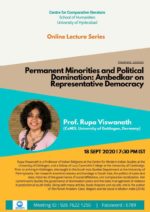
Centre for Comparative Literature at University of Hyderabad conducts series of online lectures on various topics featuring prominent academicians across the globe. The inaugural lecture will be delivered by Prof. Rupa Viswanath (Centre for Modern Indian Studies, University of Göttingen).

Title: “Permanent Minorities and Political Domination: Ambedkar on Representative Democracy”

Date: 18 Sept 18 2020
Time: 7.30 PM, IST

Link to join Zoom Meeting: https://zoom.us/j/92676221250?pwd=ZWYveTgraGV6RGVRNHdMbTJDd3crdz09

Meeting ID: 926 7622 1250
Password: 6789

About the Speaker: Rupa Viswanath is a Professor of Indian Religions at the Centre for Modern Indian Studies at the University of Göttingen, and a Fellow of Lucy Cavendish College at the University of Cambridge. Prior to arriving in Göttingen, she taught in the South Asia Studies Department at the University of Pennsylvania.

Her research examines slavery and bondage in South Asia, the politics of caste and class, histories of the governance of social difference, and comparative racialization. Her current work studies the governance of dominated castes and the state management of violence in postcolonial south India. Along with many articles, book chapters and op-eds, she is the author of The Pariah Problem: Caste, Religion and the Social in Modern India (2014).

Postdoctoral Fellowship in Critical Translation Studies

0
Postdoctoral fellowship in critical translation Studies

Positions are available for the 2021-22 POSTDOCTORAL FELLOWSHIP IN CRITICAL TRANSLATION STUDIES
The Department of Comparative Literature at the University of Michigan announces a one-year Postdoctoral Fellowship in Critical Translation Studies. The fellowship is funded by the Mellon Foundation in conjunction with a Mellon Sawyer Seminar on Sites of Translation in the Multilingual Midwest . The candidate will have the opportunity to pursue independent scholarship related to translation, gain teaching experience, and engage with interdisciplinary translation initiatives across the university and in the community beyond the university.

We welcome applications from scholars undertaking comparative research in histories, theories, and practices of translation, and engaging critically with current debates in the field. While we are interested in projects that focus on any language or historical period, we are particularly interested in work that either relates to the Midwestern region and its multilingual history, or in projects that engage translation in public-facing contexts (including medical, legal, political, environmental, journalistic, literary, artistic, and other forms of community engagement).

The recipient will be appointed as a postdoctoral fellow for a one-year term beginning August 1, 2021 and is expected to be in residence during the academic year. The postdoctoral fellow will teach one course related to the Minor in Translation Studies, and be actively involved in helping coordinate activities related to the Sawyer Seminar. Mentoring and professional development training will also be an integral component of the position. The remainder of the fellow’s time will be devoted to pursuing research. Starting salary will be $60,000 plus benefits.

Applications must be submitted via email to complit-positions@umich.edu no later than October 15, 2020. Applications must include the following as separate pdf attachments: cover letter with c.v. and dissertation abstract, research statement, teaching statement, writing sample related to critical translation studies (20-30 pages), three reference letters. The University of Michigan and the Department of Comparative Literature are committed to the core values of diversity, equity, and inclusion. Applicants are welcome to comment, either in the cover letter or in a separate statement, on how their research, teaching, and/or service experience will enhance our efforts to support these values and the needs of an increasingly diverse student population.

Eligibility

Fellows must hold a PhD in a humanities discipline or in the humanistic social sciences.

To be eligible for this competition, the doctoral degree must be received between January 2017 and August 2021.

Applicants must be scholars who are not yet tenured, and do not hold a PhD from the University of Michigan.

Applicants who do not yet hold a PhD but expect to file their final thesis prior to the starting date of the fellowship must provide a letter from their home institution (department chair, head of graduate studies, or advisor) confirming the degree award schedule

Selected recipients may not hold another fellowship simultaneous with this one.

For more information, please visit the official website here

KTDRR’s 2020 Virtual Conference: Social Media Strategies for Knowledge Translation

0
KTDRR’s 2020 Virtual Conference: Social Media Strategies for Knowledge Translation

KTDRR’s 2020 Virtual Conference: Social Media Strategies for Knowledge Translation

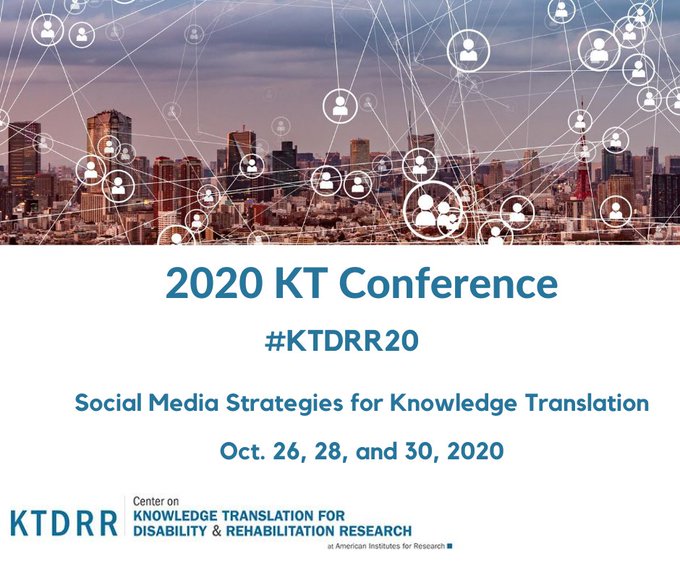
KTDRR’s 2020 Virtual Knowledge Translation Conference theme is  is “Social Media Strategies for Knowledge Translation.” Presenters will address key questions pertinent to any researcher or product developer: How can social media help me understand what people need? or want to know from my work? How can it be used as a tool to involve individuals and organizations as I plan a project and get it up and running? The conference will also include discussions of using social media to recruit research participants and ensure ongoing stakeholder engagement. Throughout the conference, careful attention will be paid to making sure these social media strategies are accessible to people with disabilities.

Participants will be able to view and ask questions through the event’s virtual conference platform. #KTDRR20 will take place from 1:00 p.m. to 5:00 p.m. Eastern Time on October 26, 28 and 30, 2020.

  • Monday, October 26, 2020: “Start with the end in mind: Using social media to design outcomes”
  • Wednesday, October 28, 2020: “Meet them where they’re at: Using social media for subject recruitment and stakeholder engagement”
  • Friday, October 30, 2020: “Making a difference with social media” 

Registration is free and open to the public (registration will close at 11:59 p.m. Eastern Time on Friday, October 23, 2020). Participants will listen to the conference using their computer/tablet speakers and will interact by way of the chat box. Each day will include live polls as well as interactive discussions with volunteer reactors following each presentation. CART and accessible options will be available.

To know more about the event and register for the virtual conference, Please click here

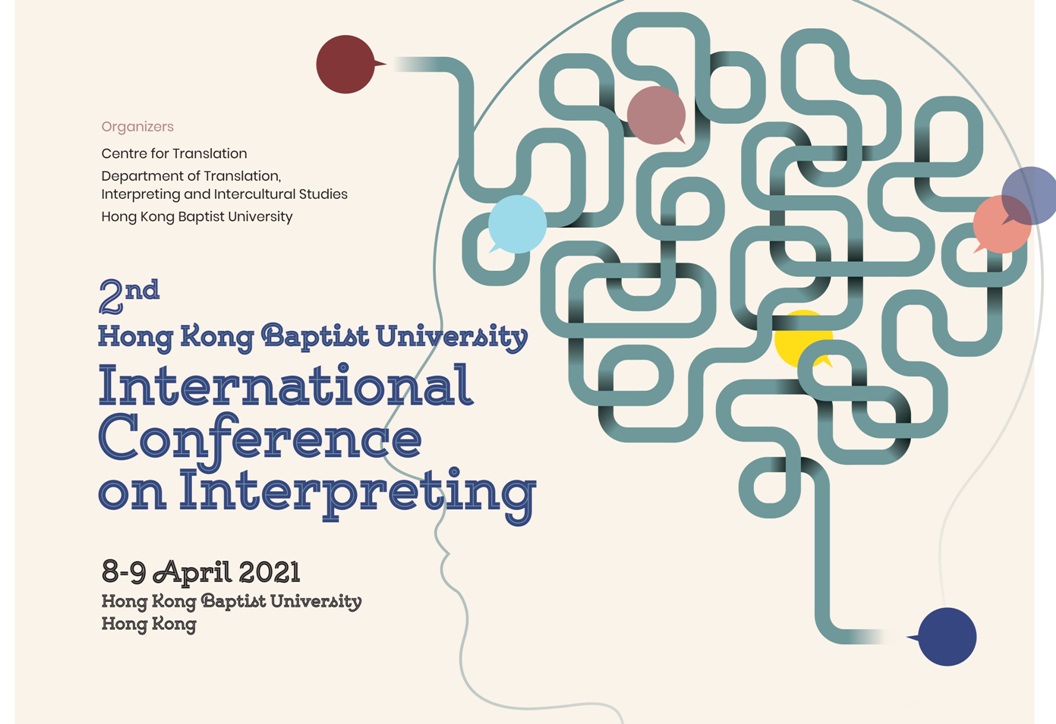
Second Hong Kong Baptist University International Conference on Interpreting

0

Second Hong Kong Baptist University International Conference on Interpreting

Theme

COGNITIVE APPROACHES

Dates

8-9 April 2021

Venue

Dr. Wu Yee Sun Lecture Theatre (WLB109)
Shaw Campus
Hong Kong Baptist University

Organizers

Centre for Translation
and Department of Translation, Interpreting and Intercultural Studies
Hong Kong Baptist University

Cognitive approaches to studying interpreting have been one of the main streams of research in Interpreting Studies since the 1970s. Recently, as new perspectives continue to form and new methodologies continue to be adopted and as a result of increasing inter-disciplinary cross-pollination, the field of Interpreting Studies has seen a resurgence of cognition-related research, not only in spoken language interpreting, but also in signed language interpreting. Riding on this exciting new wave and continuing our tradition of having a targeted theme, we aspire to use this platform to bring together top and promising scholars in both spoken language interpreting and signed language interpreting to Hong Kong.

This conference is the second “Hong Kong Baptist University International Conference on Interpreting”.

KEYNOTE SPEAKERS

Speaker:
1. Adolfo GARCÍA

(Cognitive Neuroscience Center, UdeSA, Argentina; Global Brain Health Institute, UCSF, USA)
Title: What’s Special about the Interpreter’s Brain? A Neurocognitive Tale of Expert Bilingual Processing
Speaker:

2. Brooke MACNAMARA

(Case Western Reserve University, USA)

Title:

Interpreting as Complex Human Performance: The Role of Cognitive Abilities, Experience, and Task Demands

CALL FOR PAPERS

We welcome oral presentations and posters on both basic and applied research that fit the sub-themes of the conference or that are related to the conference theme in a broader sense.

Sub-themes:

  • bimodal and unimodal bilingualism and their implications in interpreting studies
  • modality (bimodal or unimodal) effects in interpreting
  • cognitive processes and constructs in different modalities and modes of interpreting
  • neurological substrates of interpreting
  • attention and memory in interpreting
  • cognitive workload in different modes of interpreting
  • cognitive considerations in machine-aided interpreting
  • cognitive abilities as interpreting aptitude
  • cognition-informed training of interpreters
  • skill acquisition and attrition in interpreters
  • interpreter’s cognition throughout the life span

The language of the conference is English.

Length of presentations: 30 minutes (20 minutes for presentation and 10 minutes for discussion

Poster presentation sessions will be held during the conference breaks. Poster presentation guidelines will be sent with the notification of acceptance.

Submissions must include the following information:

name of author(s)

affiliation

email address

title and an abstract of 300-400 words

3-5 keywords

short author biography of 50 to 100 words

All submissions must be submitted in Word 2010 or later versions to ctn@hkbu.edu.hk by 15 November 2020. Notifications of acceptance will be sent by email by 15 December 2020.

For detailed information please visit the official website here

10th AIETI International Congress 2021: Transtextual and cultural circumnavigations

0

10th AIETI 2021 International Congress

17 – 19 June 2021 | University of Minho, Braga

The University of Minho, through its Institute of Letters and Human Sciences (ILCH) and the Center for Humanistic Studies (CEHUM), will organize the 10th International Congress of the Iberian Association of Translation and Interpretation Studies (AIETI), which will take place on the  17th , 18 and 19 June 2021 , at the UMinho Gualtar Campus (Braga).

This will be the first time that an event of this nature will take place in Portugal under the auspices of AIETI, being, therefore, a unique opportunity for the promotion of transdisciplinary dialogue and enrichment, as well as the sharing and crossing of experiences in the context of research in Translation and Interpretation Studies, not only in the Iberian Peninsula, but also in the Lusophone space.

The conference aims, as enshrined in article 3 of the AIETI Statutes, to promote reflection, study and research, teaching and scientific exchange within the various domains / areas of translation and interpretation, as well as their positioning, impact and social value and cultural.

Under the sign of travel, crossing and itinerancy, but also of hospitality, dialogue and welcome, the event aims to promote fruitful reflection and discussion around the multiple dynamics associated with the transmission and dissemination of language, culture and knowledge in the context of globalization through circulation of texts and ideas in translation.

Recovering the   Camonian dictum , the organization invites all people interested in taking part in this other journey through texts and languages, which intends to share and redo routes “through seas that were previously navigated”, fixing, mapping and rewriting new cartographies of a “wide illuminated world” . The languages ​​of the congress will be Spanish, English and Portuguese.

All interested persons from academia, research, profession as well as students are invited to submit proposals for communication and dynamization / organization of thematic panels centered on the following structuring axes proposed (although not exclusively restrictive) of the conference:

  • Translation History
  • Translation Theory
  • Didactics of Translation
  • Interpretation
  • Sociology of Translation
  • Process Studies
  • Linguistics Applied to Translation
  • Activism, immigration and conflict situations
  • Tools and technologies
  • Literary translation
  • Specialized translation
  • Audiovisual translation and varieties of multimodality in translation

The communications will have a maximum duration of 20 minutes (including the time dedicated to questions / issues and debate). Poster presentation sessions, round tables and thematic panels are also planned. All communication proposals will be subject to peer review.

Papers presented at the congress can be submitted to a thematic volume of the journal Diacrítica, published in electronic format, necessarily following the journal’s peer review process.
 http://diacritica.ilch.uminho.pt/index.php/dia/about

In addition, all communications presented at the congress will be published in an e-book, available on the CEHUM and AIETI website.
http://cehum.ilch.uminho.pt/pubonline

The AIETI Prize for the best thesis of the biennium will take place during the event  .

For more information, contact aieti10@ilch.uminho.pt

Keynote Speakers

Amparo Hurtado Albir – Spain (Autonomous University of Barcelona)
Alexandra Assis Rosa – Portugal (Faculty of Arts, University of Lisbon)
Andreia Guerini – Brazil (Federal University of Santa Catarina)
Michael Cronin – Ireland (Trinity College Dublin)

Contact Information

Dates

Submission of abstracts of communications: November 30, 2020.

Acceptance response: Early January 2021.

Registration – Early Bird: until March 15, 2021.

Second phase until May 1.

Registration – Second phase: until May 31, 2021.

Registration Fees

Early Bird

Students (bachelor, master, doctorate): 70 euros.

AIETI members: 150 euros.

Non-members: 180 euros.

Second phase: After Early Bird

Students (Bachelor’s, Master’s, PhD): 85 euros.

AIETI members: 180 euros.

Non-members: 210 euros.

Registration includes participation in the congress, documentation, coffee breaks and 2 lunches.

The event will take place at the University of Minho, Campus de Gualtar, in the Pedagogical Complex II, Amphitheater B1 and adjacent rooms.

For more information, Please visit the official website here

Submission call: Translation and Women – Exploring the Indian Subcontinent

0
Call for submissions: Translation and Women

Translation as an act exists in the intersection of the creative and the critical. In engaging with different language systems it opens up new dialogic spaces. In a world that is becoming largely intolerant of multiple perspectives and where survival of a number of languages are becoming a matter of concern, translation can be one of the important means to pave the way for a more democratic and polyphonic world by allowing voices across boundaries of state and culture. A significant translation is therefore as much a political choice as it is a creative one.

In the Indian Subcontinent, one of the richest multilingual regions of the world, where language demography ranges from less than a hundred, as in the case of Andamanese to a few lakhs in case of some major languages, translation is bound to play a significant role. As a two way device, it can both abet as well as foster linguistic hegemony, depending on the way it is used. But its role is not limited to just that. The contribution of translation in bringing marginalised voices from the periphery to centre is also important from the perspective of gender studies.

Women in translation – both as translator as well as authors to be translated, have not received due attention. There is a rich tradition of women’s literature within the subcontinent but they remain largely rooted in their respective languages. Translation can play an important role here in building up a conversation across cultures and languages and let women’s voices reach a wider audience. 


This edition of SETU will focus on Translation and Women in the Indian Subcontinent. Articles and translated literature (of all genres), interviews and book reviews within 2500 words are invited from interested scholars and translators in topics related but not limited to –

 1. Women translators in Indian subcontinent

2. Translating women authors belonging to the subcontinent

3. Bridging the subcontinent with the rest of the world

4. Translations of poem, fiction, drama and other genres

5. Book reviews of important works of translation by women from the subcontinent 

6. Interviews of women translators belonging to the subcontinent

Contributors are requested to go through the given link and follow the guidelines while submitting their work. 
Link: 

https://www.setumag.com/p/write-for-setu.html
Deadline for contributor’s submission – 10th November 2020
Submit your contribution to translationarticles.nabanita@gmail.com