Home Blog Page 6

Faculty Member in Translation Studies, Assistant Professor/Associate Professor

0
Faculty Member in Translation Studies

Job Description

The College of Humanities and Social Sciences at the United Arab Emirates University (UAEU) is looking for a faculty member to join the Translation Studies department. Candidates who have strong background in Translation Studies should be dedicated to excellence in teaching and field education, with maximum commitment to high professional standards. Faculty members will also conduct appropriate scholarship and research that leads to full participation in the academic life of the University and the scholarly community at large.

The faculty member, as a part of a cooperative and collegiate campus community, will advise students at the undergraduate and graduate levels, perform college service and pursue an applied and/or practice research agenda, a demonstrable research capability that will enable the candidate to develop and sustain an internally and/or externally funded research program in his/her area of expertise, publish his/her research in refereed journals, and actively engage in promoting the College as well as the Department of Languages and Literature.

About United Arab Emirates University

The United Arab Emirates University (UAEU) is the UAE’s premier teaching and research institution. The first national university in the UAE, founded in 1976, the UAEU is among the nation’s most academically diverse universities offering 52 Bachelor’s degree programs, 37 Master’s programs, a Doctor of Medicine (MD), several PhD programs, and a Doctor of Business Administration (DBA). The QS world ranking recently recognized UAEU in the top 300 universities and 27th best ‘Young’ university globally. With a faculty numbering more than 930 and nearly 14,000 students from 64 nationalities, the flagship university is always striving for self-improvement and holds accreditation with WSCUC, ABET and AACSB. As part of the University’s strategic plan there is a clear agenda to achieve international research stature, by partnering with industry and international research organizations to provide research solutions to challenges faced by the nation, the region, and the world.

The University’s programs and research continue to garner national and global recognition and rankings. This is attributable to research output increasing by more than 50% in high ranked journals in the past five years and more than half of UAEU’s research output is published in top quartile journals. UAEU has built its reputation on excellence through cultural diversity; integrity and transparency; innovation; collaboration; engagement; transformation and student focus.

Minimum Qualification

The successful applicant will hold an earned Ph.D. in the discipline from an accredited university and will meet the qualifications for the relevant rank. As the language of instruction and operation is English, the applicant must have native or near native capacity to teach and write in English. The successful applicant will also have a record of refereed publications and an agenda of on-going research, or evidence of noteworthy scholarly promise in the case of younger scholars. He or she will also exhibit a commitment to a student-centered approach to teaching.

Special Instructions to Applicant

Subject to timeliness for the successful applicant, this appointment will commence in January 2021.

Division College of Humanities &S. Sc.(CHSS)
Department Languages and Literature- (CHSS)
Job Close Date 27-09-2020
Job Category Academic – Faculty

To apply for the post please visit the official website of the University

Webinar talk: Considering the Thermodynamics of Translation

0

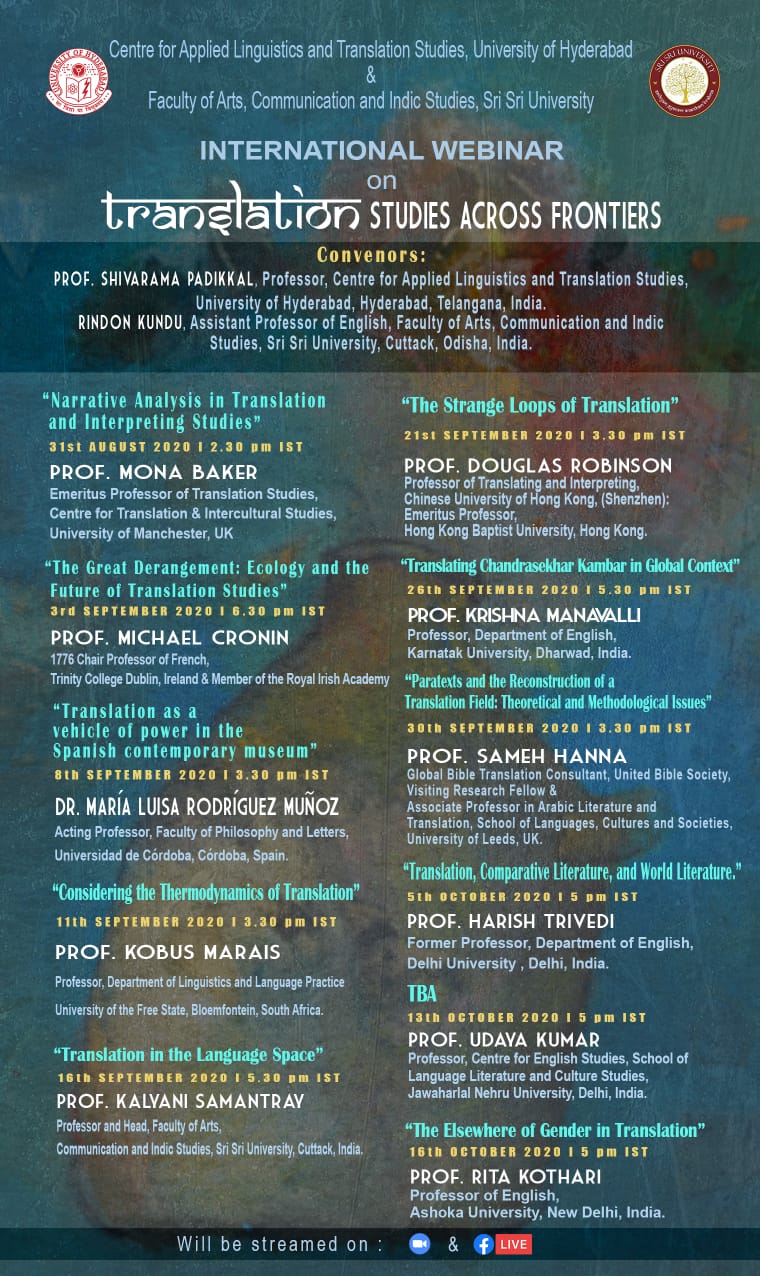
International Webinar on ‘Translation across Frontiers’

Plenary-3

Guest Speaker: Prof. Kobus Marais,
Professor, Department of Linguistics and Language Practice
University of the Free State, Bloemfontein, South Africa;
Vice-president, Association for Translation Studies in Africa
Topic: “Considering the Thermodynamics of Translation.”
Join Zoom Meeting:
https://zoom.us/j/93669752158?pwd=NHdnMzFBTzhZZ0tuSERVZVR5Q3pQdz09

Date: 11th September, 2020
Time: 03:30 PM Indian Standard Time

Meeting ID: 936 6975 2158
Passcode: 733407

This session will be live streamed on the Official FB Page of Sri Sri University https://www.facebook.com/srisriu

The Great Derangement: Ecology and the Future of Translation Studies

0

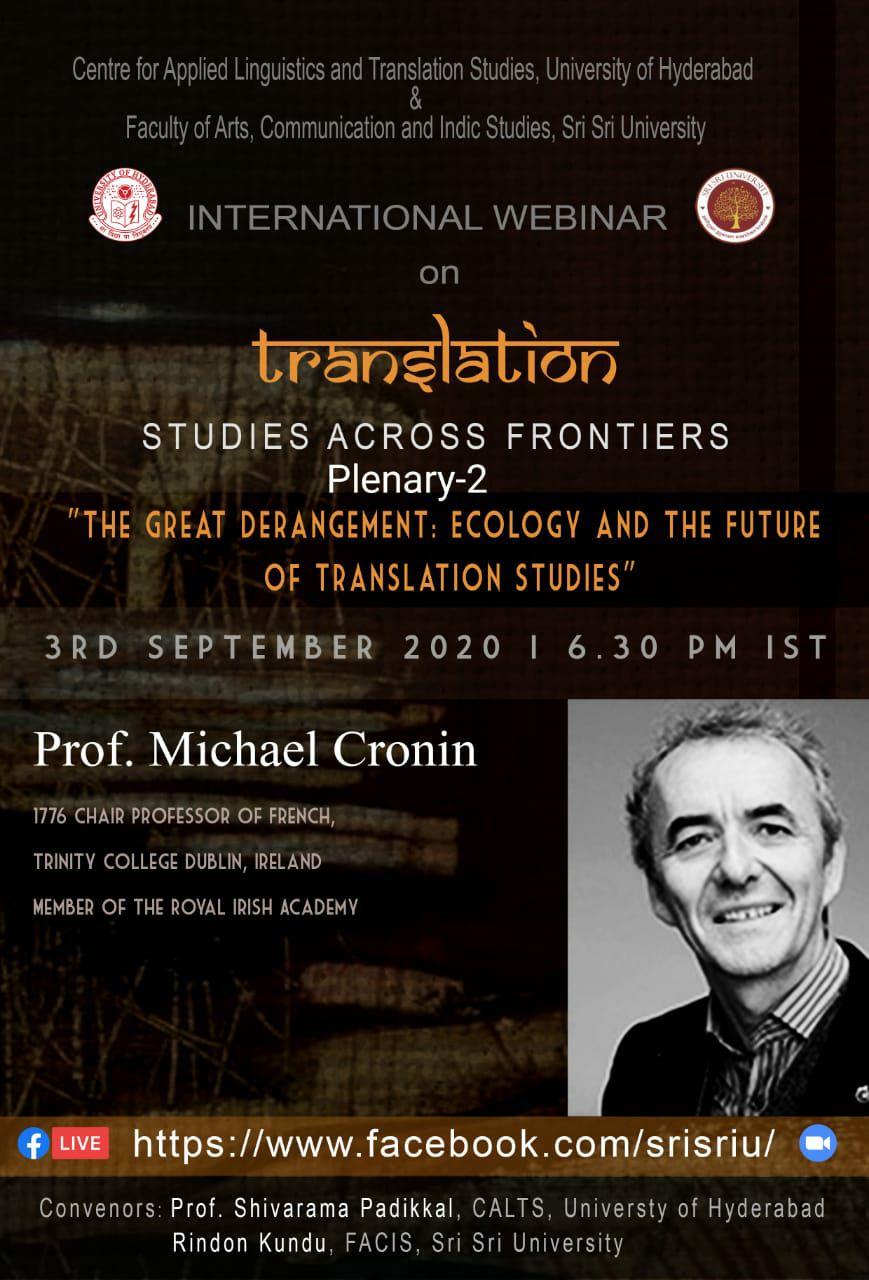
The second plenary of the International Webinar series ‘Translation Studies across Frontiers’ jointly organized by the Centre for Applied Linguistics and Translation Studies, University of Hyderabad and Faculty of Arts, Communication, and Indic Studies, Sri Sri University, Cuttack is titled as “The Great Derangement: Ecology and the Future of Translation Studies”. The talk will be delivered by Prof. Michael Cronin, the 1776 Chair Professor of French, Trinity College Dublin, Ireland at 6.30 PM IST on September 3, 2020.

The ZOOM LINK of the event is given below

https://zoom.us/j/93664244999?pwd=TGVkT25FZ1BaR283S0RXNktkV28xQT09
Meeting ID: 936 6424 4999
Passcode: 127188

This session will be live streamed on the Official FB Page of Sri Sri University https://www.facebook.com/srisriu

International Webinar : “Translation Studies across Frontiers”

0

Organizers

Centre for Applied Linguistics and Translation Studies, University of Hyderabad

Faculty of Arts, Communication and Indic Studies, Sri Sri University

Convenors: Professor Shivarama Padikkal, Centre for Applied Linguistics and Translation Studies, University of Hyderabad, Hyderabad, Telangana, India.

Rindon Kundu, Assistant Professor, Faculty of Arts, Communication and Indic Studies, Sri Sri Uni versity, Cuttack, Odisha, India.

Date: 31 Aug – Sept 16, 2020

Concept Note:

Translation studies is moving into new spaces and opening up new horizons. The books and Papers being published in the realm of translation studies in recent years are exciting and thought-provoking. Our perception of the ‘everyday’ has been transformed radically and productively by such intellectual endeavors. The understanding that translation shapes and takes shape within culture, and that, like any other discourse, it too operates within the structures of power, has resulted in a multitude of explorations and research in translation studies asking new questions.

The questions of nation, modernity, colonialism, post-colonialism, globalization, gender, minority, domination, hegemony, resistance, identity, subjectivity, cities, conflict, multilingualism, ethnography, ecology, cultural difference and cultural translation, to name a few, have been raised within the new interdisciplinary space of translation studies, opened up by way of questioning the ‘humanist’ assumptions underlying the enterprise of translation and the conventional analytical categories used to study it. That apart, the digital communication, speedy travel of texts across cultures and audio visual translation bring forth new contexts, problems and issues. Several scholars of translation studies the world over have published fascinating and productive research in recent years.

Today, translation is understood in its broadest as well as metaphorical sense to indicate most modes of communication and production of a variety of texts and discourses across borders. In a way, translation marks human desire for ‘hybridity’ that governs cultural contact, transforming cultures, signsand symbols. It strives to construct an inclusive and differential cosmopolitan subjectivity. Translation as an act defies frontiers and represents “in-between spaces” that “provide the terrain for elaborating strategies of selfhood – singular or communal – that initiate new signs of identity, and innovative sites of collaboration, and contestation, in the act of defining the idea of society itself. (Bhabha, 1994) In this background the International Webinar on “Translation Studies across Frontiers” is a humble attempt to enable students of translation studies to comprehend new contexts, issues, ideas and theories.

The webinar will also try to find out how other disciplines can affect and contribute towards the discipline. Our effort is to bring learned scholars and keen students of translation studies together to exchange ideas and to have a meaningful interaction.

Call for journal submission: Foreign Literatures and Languages

0

Deadline: February 1, 2020

Xanthos: A Journal of Foreign Literatures and Languages

Xanthos: A Journal of Foreign Literatures and Languages is a double-blind, peer-reviewed, academic journal based within the University of Exeter in Exeter, UK. 

Following the success of our inagural issue, we welcome submissions for our second annual issue, to be published in summer 2020.

We invite contributions that draw on (but are not limited to) literary theory and criticism, comparative literature, reception studies, philosophy and literature, translation studies, and linguistics. 

We are particularly interested in submissions that are interdisciplinary in nature, and which bring language research into dialogue with historical, philosophical, economic, and political questions.

Xanthos also welcomes translations from foreign languages into English, particularly texts which have not been previously published in English.

Contributions should be accompanied by a 200-word abstract and a brief biography.

Submissions should be written in English, be between 5,000 and 8,000 words in length, and follow MHRA style. 

To view our full author guidelines and editorial policy, please visit the official website http://xanthosjournal.com/

The Martha Cheung Award for Best English Article in Translation Studies

0

The Jiao Tong Baker Centre for Translation and Intercultural Studies is pleased to announce the launch of The Martha Cheung Award for Best English Article in Translation Studies by an Early Career Scholar

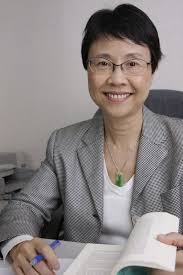
The Award is established in honour of the late Professor Martha Cheung (1953-2013), formerly Chair Professor of Translation at Hong Kong Baptist University. Professor Cheung was an internationally renowned scholar whose work on Chinese discourse on translation made a seminal contribution to the reconceptualization of translation from non-Western perspectives. For a brief biography and a list of her most important publications, see Professor Martha Pui Yiu Cheung’s Publications.

The Martha Cheung Award aims to recognize research excellence in the output of early career researchers, and to allow them, like Professor Cheung herself, to make their voices heard in the international arena and play a role in charting the future directions of research in the discipline. The restriction of the award to articles published in English is also intended to ensure consistency in the assessment process.

The Award

The award is conferred annually for the best paper published in English in the previous two-year period, and takes the form of a cash prize of 10,000 RMB. A certificate from the Jiao Tong Baker Centre for Translation and Intercultural Studies will also be presented.

Eligibility

  • Applicants must have completed their PhD during the five-year period preceding the deadline for submission of applications.
  • Given the emphasis on early career scholars, the award is restricted to single-authored articles: co-authored articles will not be considered.
  • The scholarly article submitted must be already published. Work accepted for publication but in press will not be considered.
  • The term ‘published’ also covers online publication
  • The article must have been published within 5 years of the applicant gaining his or her PhD degree.
  • The article must have been published in English, in a peer-reviewed journal of good standing. Book chapters and entries in reference works do not qualify.
  • The article does not have to have appeared in a journal of translation or interpreting. Journals of media, linguistics, postcolonial studies, cultural studies, etc. all qualify, as long as the article engages with translation/interpreting in a sustained manner.
  • Submissions will be assessed solely on their scholarly merit, as judged by a panel of established scholars; considerations such as formal journal ranking and impact factor will not form part of the judging criteria.
  • The article may present research relating to any area of translation, interpreting or intercultural studies, and may draw on any theoretical models or methodologies.

Submission

Applicants may apply directly themselves for the award, or their work may be nominated by other scholars. A full copy of the article should be submitted in e-copy, in pdf format, together with the completed application/nomination form, downloadable here. Completed applications should be sent to the Award Committee at this address: ctn@hkbu.edu.hk.

Timeframe

For the submission of articles published between 30 September 2017 and 30 September 2019:

Application closing date for the 2020 Award: 30 September 2019

Announcement of award winner: 31 March 2020

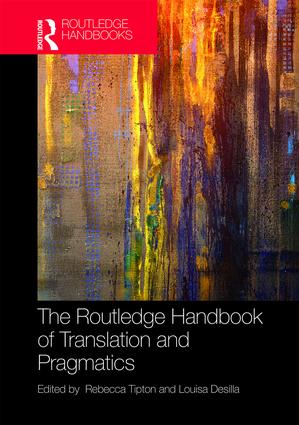
The Routledge Handbook of Translation and Pragmatics is out!

0

The Routledge Handbook of Translation and Pragmatics provides an overview of key concepts and theory in pragmatics, charts developments in the disciplinary relationship between translation studies and pragmatics, and showcases applications of pragmatics-inspired research in a wide range of translation, spoken and signed language interpreting activities.

Bringing together 22 authoritative chapters by leading scholars, this reference work is divided into three sections: Influences and Intersections, Methodological Issues, and Applications. Contributions focus on features of linguistic pragmatics and their analysis in authentic and experimental data relating to a wide range of translation and interpreting activities, including: news, scientific, literary and audiovisual translation, translation in online social media, healthcare interpreting and audio description for the theatre.

It also encompasses contributions on issues beyond the level of the text that include the study of interpersonal relationships in practitioner networks and the development of pragmatic competence in interpreter training. Each chapter includes many practical illustrative examples and a list of recommended reading.

Fundamental reading for students and academics in translation and interpreting studies, this is also an essential resource for those working in the related fields of linguistics, communication and intercultural studies.

techLING 2019 : IV International Conference on Language, Linguistics and Technology

0

techLING 2019, IV International Conference Language, Linguistics and Technology
October 9 to 11, 2019
A Coruña (Spain)
http://ceh.ilch.uminho.pt/techling2019/?lang=en

techLING is an international conference devoted to the application of technology to languages. We are looking for contributions that present different technology-based approaches, both academic and non-academic, to the study, use and commercialization of languages.

We welcome paper and poster proposals that fall under one or more of the following topics, which we have grouped into four main tracks:

Track 1: Language Teaching

Digital teaching resources
Blended learning
Languages for specific purposes
Flipped classroom
Data-driven learning

Track 2: Gamification /Transmedia

Podcasts Transmedia and storytelling
Serious games for learning
Game-based instruction
Interactive learning based on simulations and games
Audiovisual content applied to teaching

Track 3: Computational Linguistics

Natural language processing
Text mining
Sentiment analysis
Automatic tagging

Track 4: Corpus Linguistics

Corpus compilation and design
Corpus annotation
Types of corpora
Corpus query tools
Corpus exploitation

Important dates
—————

September 10, 2019: Submission of abstracts

September 17, 2019: acceptance notification

September 18 to September 30, 2019: registration

October 9 to 11, 2019: congress techLING

January 31, 2020: article submission

Submissions
———–

Abstract submission

Each participant may submit up to two abstracts, which must not exceed 300 words nor five keywords, in one of the working languages of the conference (Portuguese or Galician, Spanish, French, Italian and English). It is recommended that you follow APA guidelines, structuring the text as follows: identification of the topic, objective, methodology (sample, instrument and procedure), results and conclusion. In the abstract all sections should be presented in a concise manner, especially the Results section. If your study does not have an empirical basis, the abstract should have the structure of a theoretical study: identifying the theoretical approach or model and linking current and past results.

Submission guidelines

Submission of abstracts is made exclusively through the Easychair platform (https://easychair.org/conferences/?conf=techling19). If you do not have an account, you must create it following the instructions available on the platform’s website.

Until September 17, 2019 participants will be notified of the decision regarding acceptance of their abstract and whether it was accepted for the intended type of presentation or whether any changes have been suggested.
Article submission

The studies presented in each of the four tracks could be submitted for further publication in special issues of the following scientific journals:

Tracks 1 and 2: Revista de Humanidades Digitais, H2D.
Track 3: LinguaMÁTICA. Note that the articles of LinguaMÁTICA should be written in one of the main languages of the Iberian Peninsula.
Track 4: Research in Corpus Linguistics (RiCL) journal.

The presentation of a study in techLING does not mean that the article will be accepted by the journal, since each of these publications has independent review processes.

International Doctorate in Translation Studies: first workshop for supervisors

0

International Doctorate in Translation Studies

Event Details

Date: 9. September, 2019
The first workshop for supervisors that will be organised on 9 September 2019 just before the next EST congress in Stellenbosch in South Africa and will be led by Professor Anthony Pym.

The title of the workshop: How to supervise doctoral research on translation and interpreting?

Participants: Supervisors or potential supervisors of doctoral candidates.

Seminar 1 (90 minutes): A survey of the culturally different modes of supervisor-candidate relations; identification of common problems; identification of problems in some way specific to translation and interpreting (especially as involving cross-cultural relationships); the ethical aims of the supervisor-candidate relationship; a list of quandaries, non-ethical situations and other traps that supervisors can fall into; when not to supervise; the overriding need for contractual clarity.

Seminar 2 (90 minutes): Group work on real-world cases of problematic doctoral students and/or problematic research designs. Each group will decide how the supervisor should react; the various decisions will be compared an discussed; the real-world outcomes will then be revealed.

Preliminary reading:

Pym, Anthony. 2012. Research skills in translation studies. What we need training in. Across 14/1 (2013). 1-14.

http://usuaris.tinet.cat/apym/on-line/research_methods/2012_research_skills.pdf

The participation at the workshop for all supervisors from the members of ID-TS network is free of charge.

New Publication: Music and Translation: New Mediations in the Digital Age

0

This book explores how transformations and translations shape musical meanings, developments and the perception of music across cultures. Starting with the concept of music as multimodal text, the author understands translation as the process of transferring a text from one language – verbal or not – into another, interlingually, intralingually or intersemiotically, as well as the products that are derived from this process. She situates music and translation within their contemporary global context, examining the tensions between local and global, cosmopolitan and national, and universal and specific settings, to arrive at a celebration of the translational power of music and an in-depth study of how musical texts are translated. This book will be of interest to translation studies scholars who want to broaden their horizons, as well as to musicians and music scholars seeking to understand how cultural exchange and dissemination can be driven by translation.